
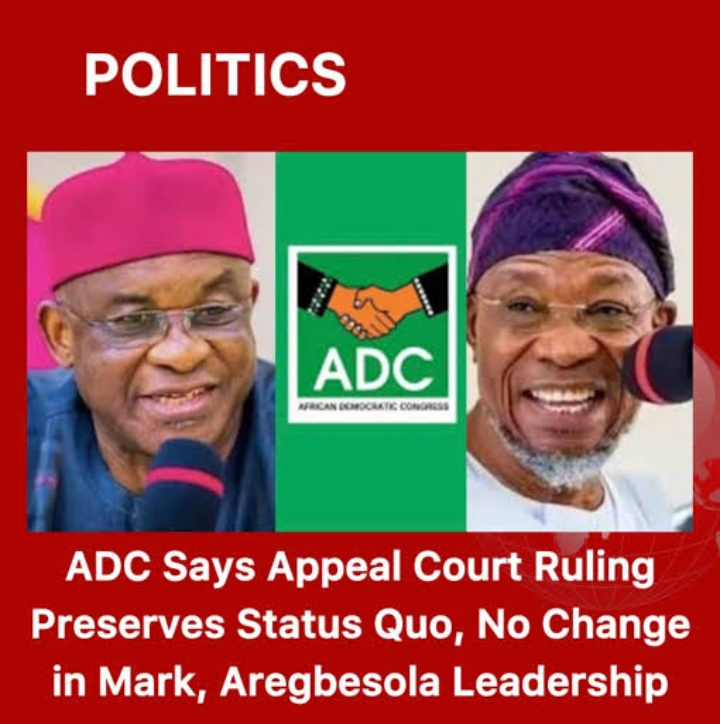
Nigeria’s electoral umpire, the Independent National Electoral Commission (INEC), has withdrawn its recognition of the factional National Working Committee (NWC) of the African Democratic Congress (ADC) reportedly led by David Mark, triggering a fresh political crisis within the opposition party.
The decision, which stems from INEC’s interpretation of a recent Court of Appeal ruling, has deepened the leadership dispute rocking the ADC at a time of heightened political realignments ahead of the 2027 general elections.
ADC Rejects INEC Decision
Reacting swiftly, the party’s spokesperson, Bolaji Abdullahi, rejected INEC’s stance, describing it as flawed and politically motivated.
In a strongly worded statement, Abdullahi accused the electoral body of bowing to external pressure, alleging that the move was aimed at weakening the growing influence of the ADC.
“We reject INEC’s interpretation of the Court of Appeal ruling. The commission’s statement is riddled with contradictions that defy logic and facts,” he said.
He further claimed that the commission had “caved to pressure from a jittery government,” suggesting that the ADC’s rising popularity had unsettled political opponents.
Legal Battle Looms
The party disclosed that it is currently reviewing its legal options and may challenge INEC’s decision in court.
This development signals a likely protracted legal showdown that could determine the legitimate leadership of the party and shape its participation in future elections.
Political observers note that internal disputes over party structure and leadership legitimacy have become a recurring issue across several opposition parties in Nigeria.
Internal Crisis and Rival Claims
The controversy is reportedly linked to competing claims over the party’s leadership structure, including disputes involving figures such as Nafiu Bala, whose position within the party has been a subject of contention.
Critics argue that the crisis reflects deeper structural issues within the ADC, including allegations of irregular leadership changes and lack of due process.
Public Reactions and Political Implications
The development has sparked mixed reactions among Nigerians, especially on social media platforms, where opinions remain sharply divided.
While some commentators support INEC’s decision as a necessary enforcement of party rules, others view it as a politically influenced move capable of undermining opposition unity.
The controversy comes amid broader political tensions, defections, and strategic alliances shaping Nigeria’s political landscape ahead of the next general elections.
What This Means Going Forward
INEC’s derecognition of the disputed ADC leadership could have far-reaching implications, including:
-Potential exclusion of the faction from official electoral processes,
-Escalation of internal party conflicts
Increased judicial intervention in party affair and
-Further fragmentation of opposition forces
As the situation unfolds, all eyes will be on the courts and INEC for the next steps that will determine the future of the ADC.
Conclusion
The ADC crisis underscores the fragile nature of party politics in Nigeria, where leadership tussles and legal battles often shape political trajectories.
With the party vowing to challenge INEC’s decision, the coming weeks are expected to be decisive in resolving the dispute—or deepening it further.






, has withdrawn its recognition of the National Working Committee (NWC) of David Mark)