


United States President Donald Trump has announced that the U.S. will assume the role of the “Guardian of the Hormuz Strait” and impose a 20% fee on all cargo passing through the strategic waterway, a move that could have far-reaching consequences for global trade and oil markets.
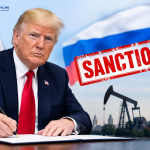
In a post on his Truth Social platform on Monday, Trump said the United States would reinstate a naval blockade targeting Iranian ships and their customers, while allowing vessels from other countries to continue using the Strait of Hormuz.
According to Trump, the 20% charge is intended to reimburse the United States for the costs of providing security in one of the world’s busiest and most volatile shipping lanes.
“The U.S.A. will, from this point forward, be known as ‘THE GUARDIAN OF THE HORMUZ STRAIT’… and will be reimbursed at the rate of 20% on all cargo shipped for providing safety and security,” Trump said.
Decision Follows Iran’s Claimed Closure of Hormuz
The announcement comes after Iran claimed it had closed the Strait of Hormuz following renewed military confrontations with the United States.
The narrow waterway is one of the world’s most critical maritime routes, with roughly one-fifth of global oil supplies passing through it.
Trump insisted that the strait would remain open “with or without Iran,” signaling Washington’s determination to maintain freedom of navigation despite Tehran’s threats.
Oil Prices React
Financial markets responded swiftly to the development.
Oil prices climbed sharply amid fears that renewed conflict around the Strait of Hormuz could disrupt global energy supplies. Investors also reacted cautiously as concerns grew over potential increases in shipping costs and broader inflationary pressures.
Iran Rejects U.S. Claim
Iran rejected Trump’s declaration, insisting that the United States has no authority over the Strait of Hormuz.
Iranian officials maintained that Tehran remains the legitimate guardian of the strategic waterway and warned against any foreign interference in its territorial interests.
International Questions
Trump’s proposal has also raised legal and diplomatic questions.
Maritime experts note that the Strait of Hormuz is an international waterway governed by international law, and it remains unclear whether the United States can legally impose mandatory transit charges on commercial vessels from other countries. The proposal is expected to face scrutiny from the international community.
Why the Strait of Hormuz Matters
The Strait of Hormuz connects the Persian Gulf to the Gulf of Oman and the Arabian Sea. It serves as the primary export route for crude oil and liquefied natural gas from major producers including Saudi Arabia, the United Arab Emirates, Kuwait, Iraq and Qatar.
Any disruption in the waterway can quickly affect global energy prices, shipping costs and inflation worldwide.
What Happens Next?
It remains uncertain how the proposed 20% cargo fee would be enforced or whether shipping companies and foreign governments will comply.
Analysts say the coming days will be crucial as the United States, Iran and the international community respond to the latest escalation.
This is a developing story.