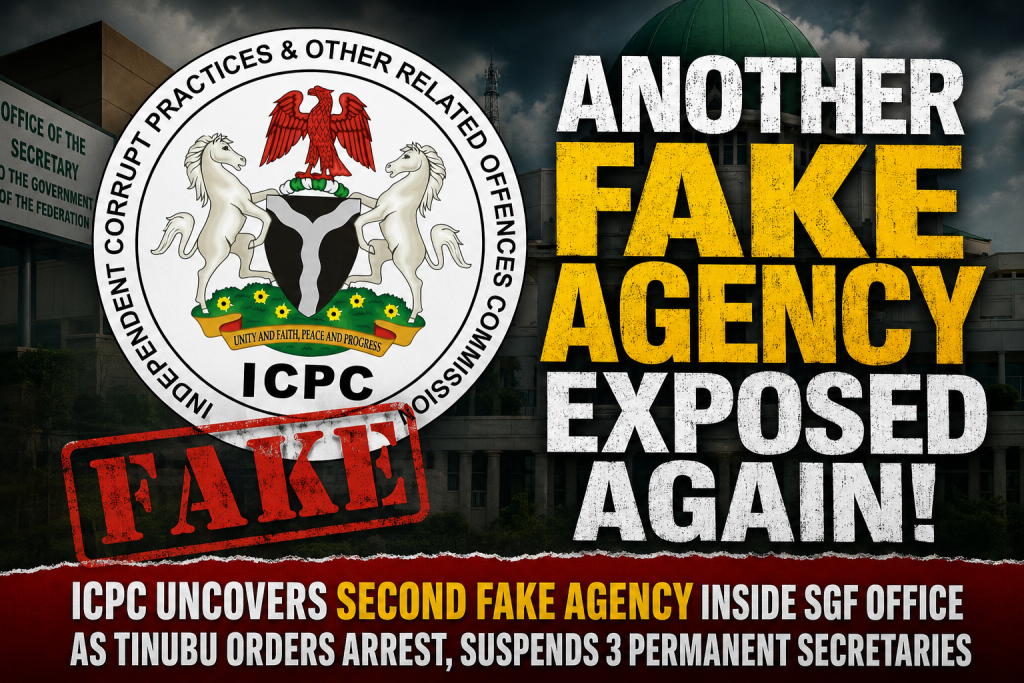
Another “Government” That Never Existed: ICPC Uncovers Second Fake Agency Inside SGF Office as Tinubu Orders Arrest, Suspends 3 Permanent Secretaries
Nigeria’s unfolding fake-agency scandal has taken a startling new turn, with the Independent Corrupt Practices and Other Related Offences Commission (ICPC) uncovering another purported government institution operating from within the premises of the Office of the Secretary to the Government of the Federation (OSGF).
READ MORE Pa Ajolore Says Nigeria Needs Transition, Not Elections; States Reasons
The latest revelation comes barely weeks after the ICPC began investigating the Presidential Foreign Investment Promotion Council (PFIPC), an organisation it has described as fictitious and which allegedly operated for some time by presenting itself as a legitimate arm of the Federal Government.
This time, investigators uncovered an organisation called the “National Brands Development and Made in Nigeria Special Project Office.”
According to the ICPC, the organisation was allegedly promoted by George Buchi Nwabueze and operated with suspected collaboration from senior public servants within the OSGF.
Another agency hiding in plain sight
What makes the latest discovery particularly disturbing is where the alleged fake agency was operating.
The ICPC said the purported organisation had been allocated office space within the OSGF premises, despite allegedly having no valid authority establishing it as a federal government agency.
The revelation was made on Friday, August 21, by ICPC Chairman Musa Adamu Aliyu, SAN, after he briefed President Bola Ahmed Tinubu at the State House in Abuja.
According to the anti-corruption commission, Nwabueze operated under several variations of his name, including Prince George Buchi Nwabueze, George Nathan and Hon. George Buchi Nwabueze.
The discovery was not made in isolation. Rather, the ICPC said it emerged from its ongoing investigation into the earlier PFIPC scandal.
How the first fake agency opened the door
The earlier investigation into the purported Presidential Foreign Investment Promotion Council has already raised serious questions about how individuals could establish and operate organisations that appeared to be government institutions without valid government approval.
In its interim findings, the ICPC said PFIPC was never created by law, executive order or any other valid government instrument.
Investigators also found that the man who allegedly paraded himself as its Director-General, Adeniyi Adeyemi, was never appointed by the Federal Government or any government authority.
The commission said appointment letters, gazettes and other official-looking documents allegedly used to support PFIPC’s existence were forged. It also uncovered two other purported fictitious agencies allegedly connected to the scheme.
Interestingly, the ICPC said its investigation found no evidence that Federal Government funds were approved or disbursed to PFIPC or its operators.
However, it identified weaknesses in verification procedures and inter-agency oversight that allegedly created an opportunity for the scheme to operate.
Tinubu reacts: Arrest ordered, three Permanent Secretaries suspended
The latest discovery has now triggered direct action from President Tinubu.
Following the ICPC briefing, the President ordered the immediate arrest of George Buchi Nwabueze.
He also ordered the suspension of three Permanent Secretaries in the Office of the Secretary to the Government of the Federation:
M.S. Danjuma
Engr. Nandungu Gagare
Richard Pheelangwa
The ICPC said the action followed its findings concerning the alleged fake agency and suspected collaboration by senior public servants.
A bigger problem than one fake agency
The latest development raises a much bigger question: How many other organisations claiming to represent the Federal Government are operating without proper legal authority?
The fact that the second alleged fake agency was discovered while investigating the first suggests that the problem may go beyond isolated impersonation.
The ICPC has already recommended institutional reforms aimed at strengthening verification mechanisms, internal controls and inter-agency oversight across Ministries, Departments and Agencies of the Federal Government.
That may ultimately prove more important than the arrest of one individual.
Nigeria has hundreds of government agencies, departments, councils, commissions and special projects. For an ordinary citizen, business owner or foreign investor, an organisation operating from a government complex, using official-looking documents and government titles can easily appear legitimate.
That creates a dangerous environment for fraud.
What the Federal Government is doing
The Federal Government’s response is now moving beyond the investigation of the original PFIPC scandal.
The ICPC’s findings have prompted the President to take immediate disciplinary and law-enforcement measures in the latest case, while the anti-corruption agency continues its investigation into the wider network of people who may have facilitated the creation or operation of the purported institutions.
The ICPC has also recommended prosecution in the earlier PFIPC case and administrative sanctions against public officers whose actions, omissions or negligence may have enabled the organisation to operate.
The President’s latest directives therefore represent a widening response to what began as an investigation into one alleged fictitious agency.
The real scandal may be the system that allowed it
Perhaps the most troubling aspect of the unfolding story is not simply that someone allegedly created a fake government agency.
It is that such an organisation could allegedly acquire an office inside the premises of one of the most important coordinating offices of the Federal Government.
That points to a potential institutional failure: someone had to recognise the organisation, grant access, facilitate office space or otherwise allow it to operate within a government environment.
The question Nigerians should therefore be asking is no longer simply, “Who created the fake agency?”
It is:
Who opened the door for it—and how many more doors remain open?
The discovery of the National Brands Development and Made in Nigeria Special Project Office has turned the PFIPC scandal from an apparently isolated case into a broader test of the Federal Government’s ability to police its own institutional identity.
For the Tinubu administration, the arrests and suspensions may be only the beginning. The real test will be whether the government can identify the loopholes that allowed purported government institutions to operate in the first place—and close them permanently.
Headlineswave will continue to follow developments as the ICPC investigation progresses.
This report is based primarily on the official statement and findings published by the Independent Corrupt Practices and Other Related Offences Commission (ICPC), with cross-checking against current reports on the President’s directives. Allegations remain subject to investigation and due process.