


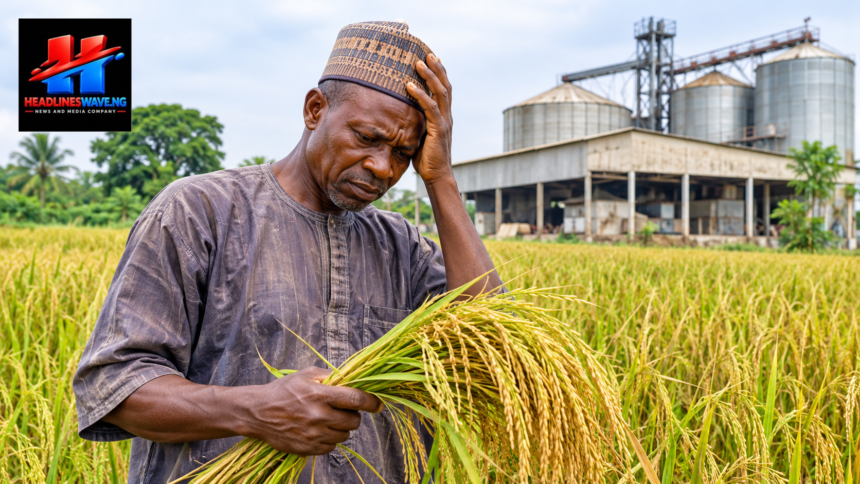
Nigeria’s Rice Industry in Crisis: Over 90 Mills Shut Down as Farmers Abandon Cultivation
Nigeria’s ambitious rice self-sufficiency drive is facing a major setback as rising production costs, declining paddy supplies and competition from cheaper imports threaten local farmers and processors.
HEADLINESWAVE.NG | BUSINESS & ECONOMY | NOVEMBER 26, 2026
Nigeria’s much-celebrated rice revolution is facing a serious reversal, with more than 90 integrated rice mills reportedly shutting down operations as farmers abandon cultivation over rising production costs and inadequate financial support.
The development raises fresh questions about the sustainability of Nigeria’s agricultural policies, particularly after years of investment in local rice production and processing aimed at reducing the country’s dependence on imported food.
More Read

Industry operators say the crisis has spread across the rice value chain, affecting farmers, processors, distributors, transporters and millions of Nigerians who depend on rice as a staple food.
A report published by Vanguard on November 23, 2026, indicates that more than 90 of Nigeria’s approximately 260 integrated rice mills have shut down, while some of the country’s major processing facilities are operating below half of their installed capacity.
The crisis is being attributed to a combination of inadequate supplies of locally produced paddy, rising agricultural input costs, expensive energy, financing difficulties and competition from cheaper imported rice.
More Read

More troubling is the possibility that Nigeria could become increasingly dependent on imported rice again, despite years of efforts to develop a domestic industry capable of meeting the country’s growing demand.
Over 90 rice mills reportedly shut down
One of the clearest indications of the industry’s difficulties is the number of processing facilities that have reportedly suspended operations.
According to the Vanguard report, Nigeria has approximately 260 integrated rice mills, with more than 90 reportedly no longer operating.
The National Chairman of the Rice Millers Association of Nigeria, Peter Dama, said the country has an installed milling capacity of approximately 7.5 million tonnes annually, but the supply of locally produced paddy is insufficient to sustain the facilities.
Nigeria currently produces approximately 4.1 million tonnes of paddy, according to the industry estimate cited in the report.
More Read

Paddy is the unprocessed rice harvested from farms and supplied to mills for processing.
The shortage of this essential raw material has left many processing facilities struggling to operate profitably.
Even major operators, including Umza in Kano and Stallion in Lagos, are reportedly operating below 50 per cent of their installed capacity.
The situation exposes a fundamental weakness in the country’s agricultural industrialisation strategy: establishing processing facilities without guaranteeing a consistent supply of affordable raw materials cannot sustain the industry.
Rising production costs force farmers to abandon rice cultivation
The increasing cost of agricultural production is another major factor undermining Nigeria’s rice industry.
According to industry operators, the price of a tonne of paddy has increased from approximately ₦180,000 in 2021 to between ₦600,000 and ₦650,000.
The cost of fertiliser has also reportedly risen from about ₦8,000 to ₦45,000, while petrol prices have increased substantially, making irrigation, transportation and other farming activities more expensive.
These rising costs have reduced the profitability of rice cultivation, particularly for smallholder farmers who lack access to affordable credit and modern agricultural equipment.
Consequently, some farmers are abandoning rice production in favour of alternative crops such as sesame and sorghum, which they consider more financially attractive under the prevailing conditions.
This development creates another problem for rice millers: even when processing facilities are available, they cannot operate efficiently without sufficient supplies of locally produced paddy.
The situation therefore threatens both agricultural production and industrial investment.
Collapse of Anchor Borrowers’ Programme creates financing gap
Industry stakeholders have also identified the discontinuation of the Central Bank of Nigeria’s Anchor Borrowers’ Programme (ABP) as an important factor contributing to the current difficulties.
Introduced in 2015, the programme was designed to provide smallholder farmers with access to agricultural inputs and affordable financing while connecting them to major processors.
Under the arrangement, participating farmers received seeds, fertilisers and other inputs on credit and repaid after harvest, often with paddy supplied to participating millers.
The programme helped expand rice cultivation and strengthen the relationship between farmers and processors.
According to figures cited by Vanguard, paddy production reportedly increased from 2.5 million tonnes in 2015 to 8.5 million tonnes in 2021.
However, the programme faced criticism over alleged political interference, poor loan recovery and the inclusion of beneficiaries who were not genuine farmers.
More than ₦1.1 trillion was reportedly disbursed under the scheme, but loan recovery was said to have fallen below 30 per cent.
The CBN discontinued the programme in 2023, and industry operators argue that subsequent interventions have not adequately replaced its financing and input-support structure.
Peter Dama reportedly estimated that more than 40 per cent of smallholder farmers who participated in the programme have since moved into other crops.
The argument from industry stakeholders is not necessarily that the programme should be restored in its original form, but that Nigeria needs a functional agricultural financing system capable of supporting genuine farmers and ensuring sustainable production.
Cheap imported rice puts local millers under pressure
Another major challenge is the competition from cheaper imported rice, including products reportedly entering Nigeria through neighbouring countries.
According to Peter Dama, imported rice is selling for between ₦52,000 and ₦60,000 per 50kg bag, compared with approximately ₦75,000 to ₦80,000 for locally produced rice.
The price difference makes imported rice more attractive to consumers already struggling with the rising cost of living.
Local millers argue that they cannot compete effectively against imported products when they have to contend with expensive paddy, diesel, transportation, labour and other operating expenses.
Dama alleged that more than 2.5 million tonnes of foreign rice had entered Nigeria through the Cotonou port and porous land borders in 2026.
That figure is an industry stakeholder’s allegation and has not been independently established in the report.
He also called for stronger border surveillance and harmonisation of regional import tariffs to reduce the incentives for illegal trade.
The challenge for the government is to protect legitimate domestic producers without creating artificial scarcity or making rice unnecessarily expensive for consumers.
Nigeria’s rice import dependence could increase
The production difficulties are already raising concerns about Nigeria’s ability to meet domestic rice demand through local cultivation.
A November 16 report by S&P Global, citing market participants and USDA projections, indicated that Nigeria could require increased rice imports as domestic production faces pressure and consumption continues to rise.
The report estimated that rice cultivation acreage could decline by 10 to 15 per cent year-on-year, with high input costs, poor yields and weak returns discouraging farmers.
The United States Department of Agriculture’s projections for the 2026/2027 marketing year also point to declining production.
It forecasts Nigeria’s milled rice production at approximately 5.67 million metric tonnes, compared with 5.90 million metric tonnes in the previous marketing year.
The USDA also projects domestic consumption at 8.8 million metric tonnes, up from 8.5 million tonnes.
These estimates suggest a widening gap between domestic production and consumption, although they should be understood within the USDA’s own marketing-year methodology.
For a country with Nigeria’s population and growing food requirements, increased dependence on imported rice could place additional pressure on foreign exchange and expose consumers to international market fluctuations.
What happened to Nigeria’s rice revolution?
Nigeria’s rice self-sufficiency drive received considerable attention under the administration of former President Muhammadu Buhari.
Through the Anchor Borrowers’ Programme, restrictions on access to official foreign exchange for rice importation and investments in local processing facilities, the government sought to reduce dependence on imported rice.
In February 2023, the Federal Government announced that Nigeria had attained approximately 75 per cent self-sufficiency in rice production.
The country also projected that it would become a net rice exporter by 2026.
The unveiling of rice pyramids in Abuja in January 2023 was presented as evidence of the progress made in domestic production.
However, the current difficulties suggest that the gains achieved during that period were not sufficiently protected by a sustainable financing, production and processing framework.
The National Rice Development Strategy II, launched in 2021, is also scheduled to expire in December 2026, creating an important opportunity for a comprehensive review of the country’s rice policy.
Federal Government disputes claims of agricultural collapse
The Federal Government has, however, pushed back against broader claims that Nigeria’s agricultural sector is collapsing.
On November 19, 2026, Minister of Agriculture and Food Security, Abubakar Kyari, dismissed claims of massive agricultural losses as unsupported by credible evidence.
Citing the 2026 Wet Season Agricultural Performance Survey conducted by the National Agricultural Extension and Research Liaison Services at Ahmadu Bello University, Zaria, the minister said national cereal production stood at 29.393 million metric tonnes, representing a 1.84 per cent increase over 2025.
He also put rice production at 9.626 million metric tonnes.
The minister rejected claims that more than half of Nigeria’s rice mills had shut down, describing the assertion as inconsistent with the state of the industry.
He said the Tinubu administration was continuing to support farmers through the Bank of Agriculture, the National Agricultural Development Fund, mechanisation partnerships, fertiliser distribution and other agricultural interventions.
The government’s position introduces an important statistical and policy disagreement that requires further clarification.
The minister’s figures are based on a national wet-season agricultural survey, while the USDA’s estimates use a different methodology and marketing-year framework. Similarly, the reported closure of more than 90 mills is not the same as a claim that more than half of all mills have shut down.
The government and industry operators therefore need to provide more detailed, independently verifiable information on actual rice production, mill operations and the availability of locally produced paddy.
What the crisis means for ordinary Nigerians
Beyond the fortunes of farmers and rice mill owners, the unfolding situation has serious implications for Nigerian households.
Rice is one of the country’s most widely consumed staple foods. Any disruption to domestic production can affect market supply, prices and household purchasing power.
If local production continues to weaken, Nigeria may become more exposed to imported rice and international price movements.
The consequences could extend beyond consumers to include rural employment, agricultural investment, food processing, transportation and distribution.
The closure of processing facilities also represents lost opportunities for employment and economic activity in communities where rice mills provide jobs and create markets for farmers.
In other words, the crisis is not simply about rice. It is about food security, industrial development, rural livelihoods and the ability of Nigeria to produce more of what it consumes.
Can the Tinubu administration rescue the rice industry?
Nigeria needs a comprehensive strategy that addresses the entire rice value chain rather than focusing on isolated interventions.
First, genuine farmers must have access to affordable financing, improved seedlings, fertilisers, mechanisation and reliable markets for their produce.
Second, the government must develop a sustainable agricultural credit programme that avoids the weaknesses associated with the Anchor Borrowers’ Programme while ensuring that financial support reaches actual farmers.
Third, local rice millers need access to affordable energy, improved infrastructure and a dependable supply of paddy.
Fourth, the authorities must strengthen border surveillance and tackle rice smuggling while ensuring that legitimate trade policies do not unnecessarily increase food prices.
Finally, federal and state governments must coordinate their agricultural policies, with clear production targets, transparent funding arrangements and measurable results.
The priority should be to make domestic rice production competitive rather than relying exclusively on import restrictions to protect local producers.
Conclusion: Nigeria cannot afford another failed agricultural revolution
The difficulties confronting Nigeria’s rice industry should serve as a serious warning to policymakers.
The country has the land, population, agricultural potential and entrepreneurial capacity to become a major rice-producing nation.
However, those advantages will count for little without consistent policies, affordable agricultural financing, reliable infrastructure and sustained support for farmers.
It makes little economic sense to invest billions of naira in rice-processing facilities only to allow them to become idle because farmers cannot afford to produce the raw materials they need.
Neither should Nigeria celebrate cheaper imported rice while domestic farmers abandon cultivation and local processors struggle to remain in business.
The ultimate objective must be affordable rice produced through a sustainable domestic agricultural system that creates jobs, protects investments, supports rural communities and reduces dependence on food imports.
For the Tinubu administration, the challenge is clear: rescue the domestic rice value chain before the present difficulties undermine more of the investments and progress made towards national food security.
The real test of Nigeria’s rice policy is not how many mills the country has built or how many bags of rice have been displayed at official ceremonies. It is whether Nigerian farmers can produce profitably, local mills can operate sustainably and consumers can afford the rice on their tables.
This report draws on the November 23, 2026, reporting by Vanguard, November 16, 2026, market analysis by S&P Global, USDA agricultural projections and the November 19, 2026, response by the Federal Ministry of Agriculture and Food Security.
The reported closure of more than 90 mills and the paddy production estimates are attributed to industry stakeholders. The Federal Government has disputed broader claims of agricultural collapse and presented different production figures. The USDA and Nigerian government figures use different statistical methodologies and should not be treated as directly interchangeable.
Sources:
Vanguard – Nigeria’s Rice Revolution Collapses as 90 Mills Shut Down.
S&P Global – Nigeria Paddy Concerns Raise Prospects for Higher Rice Imports, November 16, 2026.
United States Department of Agriculture – Nigeria Grain and Feed Market Reports.
Federal Ministry of Agriculture and Food Security – Minister’s response to agricultural production claims, November 19, 2026.