

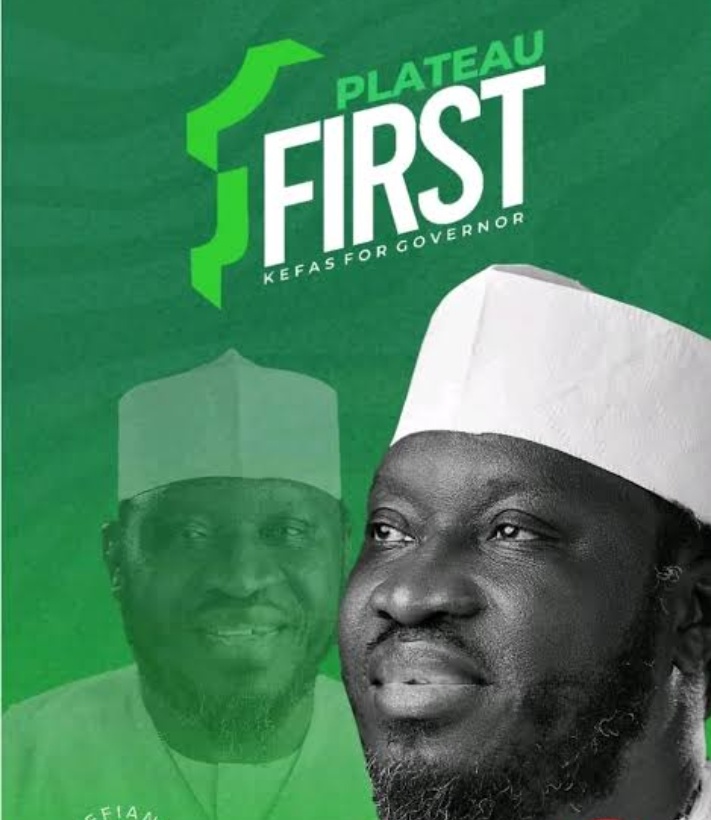
Kefiano’s Tinubu Connection: What Is Really Happening Between Plateau PDP and Wike’s Rainbow Coalition?
Also Read APM Begins Statewide Campaign in Plateau, Pledges to Prioritise Security
Plateau State’s political landscape is entering an intriguing phase ahead of the 2027 general elections.
At the centre of an unfolding political realignment is an unusual arrangement involving the Peoples Democratic Party (PDP), its governorship candidate, Chief Kefas Wungak Ropshik, popularly known as Kefiano, and the Rainbow Coalition associated with the Minister of the Federal Capital Territory, Nyesom Wike.
The arrangement raises fundamental questions about party loyalty, political ideology, electoral strategy and the future of opposition politics in Plateau State.
More Read
At the heart of the controversy is a political proposition that would ordinarily appear contradictory: a PDP governorship candidate campaigning for an APC presidential candidate while retaining his ambition to govern Plateau State on the PDP platform.
Yet, that is precisely the political arrangement Kefiano has publicly embraced.
The PDP’s internal crisis and Kefiano’s emergence
More Read
The circumstances surrounding Kefiano’s emergence cannot be separated from the protracted crisis within the PDP.
In May 2026, the Wike-backed faction of the party conducted a governorship primary in Plateau State, producing Kefiano as its candidate. He reportedly polled 19,938 votes.
However, another faction associated with Tanimu Turaki produced Sunday Garba Biggs as its governorship candidate.
This means that the PDP’s challenge in Plateau is not simply about presenting a candidate against the ruling APC. It also involves questions of internal legitimacy, factional authority and the ability to reconcile competing interests.
The emergence of competing candidates from rival factions presents an additional complication for a party seeking to reclaim power after Governor Caleb Mutfwang’s defection to the APC.
The Rainbow Coalition: A new political architecture?
More Read
The Rainbow Coalition is associated with Wike’s strategy of mobilising politicians across party lines for President Bola Ahmed Tinubu’s re-election in 2027.
Wike has defended the arrangement, insisting that it is not an APC structure and does not require members to abandon their political parties. According to him, politicians can support Tinubu for president while retaining the freedom to pursue their respective political ambitions in their states.
The Plateau Rainbow Coalition has adopted three defining declarations:
Tinubu for President.
Kefiano for Governor.
Wike is our Leader.
This is more than a presidential support arrangement. It is an attempt to create a political alignment that cuts across party boundaries while also influencing the state’s governorship contest.
The question is whether this arrangement represents political pragmatism or a departure from the traditional understanding of party loyalty.
Kefiano’s political calculation: PDP for Plateau, APC for Abuja?
Kefiano’s November 18 appearance on Channels Television’s Politics Today brought the controversy into sharper focus.
He confirmed his support for Tinubu’s re-election while maintaining his PDP governorship ambition.
When challenged about the apparent contradiction of asking voters to support an APC presidential candidate and a PDP governorship candidate, his response was revealing.
He argued that the PDP presidential candidate had no realistic chance of winning and questioned why supporters should waste their votes rather than support what he considered a viable presidential option.
He also described Plateau as fundamentally a PDP state and argued that the governor’s defection had not taken a substantial proportion of PDP supporters with him.
These were Kefiano’s political assertions, not independently established electoral statistics.
His position suggests a strategy of separating presidential voting preferences from state-level political allegiance.
But it also raises an uncomfortable question for the PDP:
If a party’s governorship candidate considers its presidential ticket unworthy of support, what message does that send to the party’s members and supporters?
A political party is ordinarily expected to offer voters a common platform, a set of political values and a coherent programme of governance.
When its governorship candidate publicly campaigns for another party’s presidential candidate, that coherence becomes a legitimate subject of scrutiny.
Wike’s influence and the question of political ownership
Wike’s role in the unfolding arrangement is particularly significant.
He remains a prominent PDP figure despite his open support for President Tinubu and his disagreement with sections of the PDP leadership.
His Rainbow Coalition has therefore introduced a political model in which party affiliation and electoral collaboration do not necessarily go together.
However, the model has generated resistance.
The arrangement has attracted criticism from political stakeholders in Plateau, including Senator Diket Plang, who has questioned the political direction and external influence associated with the emerging coalition.
His intervention reflects a wider disagreement over the extent to which political actors outside Plateau should influence the state’s political alignments.
There is also a question about the relationship between the Rainbow Coalition and the APC’s own political structure.
The APC has its official candidates, leadership and campaign organisation in Plateau. Governor Caleb Mutfwang and the state APC chairman, Rufus Bature, have been mobilising party members around the Tinubu/Shettima and Mutfwang/Piyo political structure.
Consequently, the existence of another political mobilisation platform supporting Tinubu but endorsing a PDP governorship candidate creates an obvious area of potential friction.
The contradiction facing the PDP
Perhaps the most important dimension of this development concerns the future of the PDP as an opposition party in Plateau.
The party is seeking to reclaim the Government House after Mutfwang’s defection to the APC.
Its governorship candidate is expected to provide an alternative political direction, challenge the incumbent administration and mobilise the party’s supporters.
Yet, the same candidate is openly aligned with a political movement supporting the re-election of the president whose party now controls the Plateau Government House.
This creates several questions:
Can the PDP effectively present itself as an opposition party in Plateau while its governorship candidate supports the APC presidential candidate?
How will PDP members who oppose Tinubu’s administration reconcile their political convictions with the position of their governorship candidate?
Does the Rainbow Coalition have a separate political agenda for Plateau beyond supporting Tinubu and Kefiano?
What happens when the interests of the coalition, the PDP and the APC clash during the distribution of political appointments, campaign resources and electoral support?
These are not merely theoretical questions. They go to the heart of political accountability and party identity.
Is this political pragmatism or ideological compromise?
There is an argument in defence of the arrangement.
Nigeria’s political history is replete with alliances that transcend party affiliations. Politicians frequently cooperate across ideological and partisan boundaries when they believe their interests or electoral objectives converge.
From that perspective, Kefiano’s position could be interpreted as an attempt to maximise political support at both national and state levels.
His supporters may argue that presidential and governorship elections are separate contests and that voters should be free to make different choices on the same ballot.
That argument deserves consideration.
However, political pragmatism also comes with the responsibility of explaining what a candidate represents, what political interests he intends to advance and whose mandate ultimately takes precedence.
An electoral alliance cannot indefinitely substitute for a clearly articulated political philosophy.
What does this mean for Plateau in 2027?
The unfolding arrangement introduces a new dimension to the 2027 political contest.
The PDP must contend with its internal divisions, competing governorship claims and the challenge of defining its relationship with a coalition whose presidential preference differs from its own traditional opposition posture.
The APC, on the other hand, must navigate the possibility of having its presidential candidate supported by a political structure that is simultaneously promoting a rival party’s governorship candidate.
For Plateau voters, the central consideration should be the substance of the competing political propositions.
Who has the most credible development agenda? What are the candidates’ positions on insecurity, unemployment, education, healthcare, infrastructure and the state’s economic future? And how will they translate their political alliances into measurable public benefits?
These questions should take precedence over political slogans and the personalities behind the emerging alliances.
The bigger question
The Plateau PDP, Kefiano and the Rainbow Coalition represent a fascinating case study of the changing character of Nigerian politics.
But beyond the personalities, the real issue is whether political alliances are being constructed around shared public-interest objectives or primarily around electoral calculations and political influence.
Kefiano has a right to pursue a cross-party political alliance, just as voters have the right to support different candidates at different levels of an election.
The PDP, however, must explain what its political identity represents in Plateau, while the Rainbow Coalition must clarify the boundaries between its presidential mobilisation and its state-level political ambitions.
Ultimately, Plateau is not merely a political bargaining table. It is a state whose citizens have legitimate expectations of accountable leadership, security, economic opportunity and development.
The 2027 election should therefore be about more than who supports Tinubu, who follows Wike or who flies the PDP flag. It should be about what each political arrangement offers the people of Plateau State.
This analysis draws on Kefiano’s November 18, 2026, interview on Channels Television’s Politics Today, media reports and public statements attributed to Nyesom Wike and Plateau political stakeholders.
Political claims and disputed positions have been attributed to their respective speakers rather than presented as independently established facts.