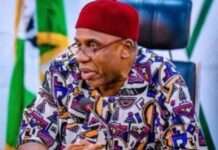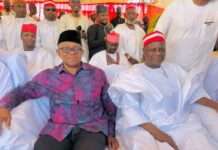
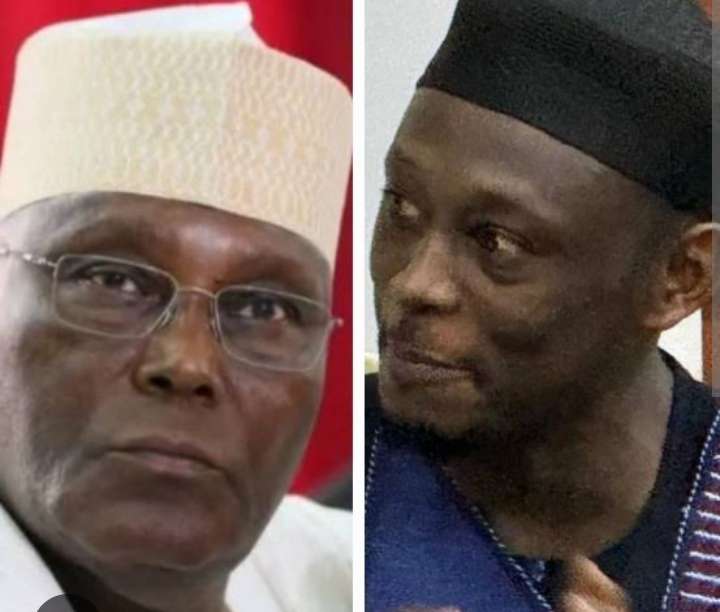
A significant political development has emerged ahead of the 2027 general elections as Abba Abubakar Atiku, son of former Vice President Atiku Abubakar, has officially defected from the Peoples Democratic Party (PDP) to the ruling All Progressives Congress (APC).
Abba announced his defection in Abuja, declaring his intention to actively support the re-election of President Bola Ahmed Tinubu.
Abba Abubakar Pledges Loyalty to APC, Tinubu
Speaking during his formal declaration, Abba described his decision as a personal political choice, saying he believes in the APC’s leadership direction and President Tinubu’s Renewed Hope Agenda.
He further directed members and coordinators of his political structure to fully integrate into the APC and mobilise support for the party ahead of the 2027 general elections.
APC leaders present at the event welcomed Abba into the party, describing his defection as a strategic boost, particularly as political alignments begin to take shape ahead of the next election cycle.
Atiku Abubakar Reacts
Reacting to the development, Atiku Abubakar said his son’s defection was entirely a personal decision and does not reflect his own political stance.
The former Vice President emphasised that democracy allows individuals — including family members — to hold differing political views. He reiterated his commitment to his political principles and continued engagement with national issues.
A Rare but Not Unprecedented Political Split
While Abba’s move has attracted widespread attention due to Atiku Abubakar’s long-standing role as a leading opposition figure, history shows that political divisions between fathers and sons are not entirely new in Nigeria.
One of the earliest documented cases dates back to 1957, when Dr. Alvan Azinna Ikoku, a prominent nationalist and educationist, contested a legislative seat in the Eastern Region on the United National Independence Party (UNIP) platform.
He was defeated in that election by his own son, Samuel Goomsu Ikoku, who ran on the Action Group (AG) ticket.
The Ikoku episode remains a landmark moment in Nigerian political history, often cited as an early example of ideological divergence within a political family, even during the pre-independence era.
Political Significance
Abba Abubakar’s defection has generated mixed reactions across political and social spaces, with analysts describing it as symbolic rather than determinative.
While some observers see the move as part of broader political realignments ahead of 2027, others argue that individual political choices — even within families — are a natural feature of democratic systems.
Conclusion
The decision by Atiku’s son to join the APC and publicly support President Tinubu adds a new layer to Nigeria’s evolving political landscape as preparations for the 2027 elections intensify.
As history has shown, political loyalty in Nigeria is often shaped by personal conviction rather than family ties — a pattern that continues to play out in contemporary politics.