

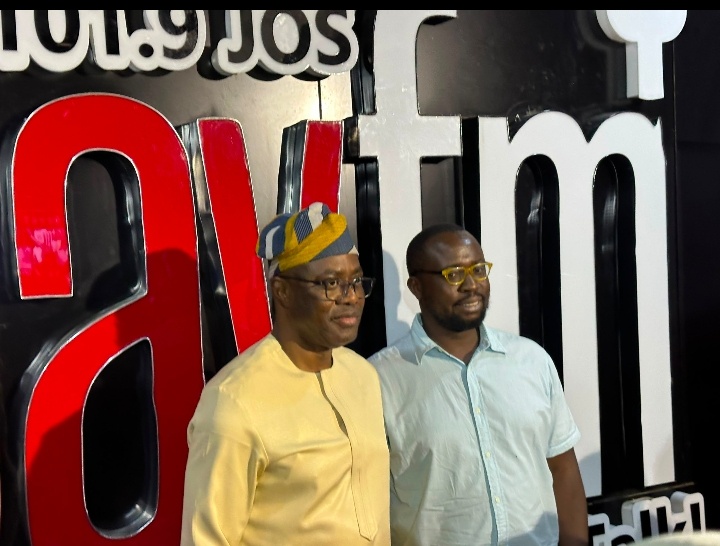
Makinde Proposes State Police, Government of National Unity in Fresh Plan to Reset Nigeria
Also Read FACT-CHECK: Did INEC Display the Voters’ Register from October 9 to 15 as Promised?
Oyo State Governor and presidential candidate of the Allied Peoples Movement (APM), Engr. Seyi Makinde, has outlined a far-reaching proposal to restructure Nigeria’s governance, security and political systems, advocating state police, a transitional government of national unity and a new approach to economic and educational development.
Makinde presented his proposals during an interview on Jay FM 101.9 Jos’ State of the Nation programme on Sunday, November 8, 2026, where he argued that Nigeria needs a fundamental national reset rather than superficial policy adjustments.
The governor identified four major pillars of his proposed national development agenda: the economy, security, education and socio-political restructuring.
More Read
His proposals form part of the APM’s broader Reset Nigeria Agenda, which seeks to address the country’s economic difficulties, worsening insecurity, educational challenges and governance concerns ahead of the 2027 presidential election.
Economy: Makinde Wants Growth to Reflect in Nigerians’ Lives
On the economy, Makinde argued that economic performance should not be judged exclusively by government statistics and macroeconomic indicators but by improvements in the living conditions of ordinary Nigerians.
More Read

He advocated greater investment in entrepreneurship, skills acquisition, knowledge development and domestic production, insisting that government must create an environment where businesses can thrive and young people can secure meaningful economic opportunities.
According to him, Nigeria needs to move towards a productive economy capable of generating employment, expanding opportunities and improving household welfare.
Security: Governor Renews Call for State Police
On security, Makinde reiterated his support for the establishment of state police, arguing that decentralising the country’s security architecture would strengthen intelligence gathering and improve responses to security threats.
He recalled being among the governors who advocated state policing during the administration of former President Muhammadu Buhari.
He also referenced the establishment of the Western Nigeria Security Network, popularly known as Amotekun, as an interim regional security arrangement.
More Read
Makinde maintained that individual states should be allowed to establish their own police structures when ready, provided appropriate constitutional safeguards are introduced to prevent political interference and abuse of power.
His position adds to the continuing national debate over decentralised policing and the capacity of Nigeria’s existing centralised police structure to address security challenges across the federation.
Education: Makinde Links Poor Access to Growing Insecurity
The APM presidential candidate also identified education as an essential component of national development and security.
He warned that inadequate access to quality education could worsen social problems, including banditry, kidnapping and insurgency, particularly when young people are denied opportunities to build productive futures.
Drawing from his personal experience, Makinde recalled receiving free secondary and university education between 1982 and 1990, including textbooks and other learning materials during his secondary school years.
He said the experience influenced his conviction that government must invest substantially in education to expand opportunities for future generations.
He also cited the resolution of the ownership dispute involving Ladoke Akintola University of Technology (LAUTECH) between Oyo and Osun States as an example of how cooperation between governments could resolve longstanding institutional disagreements.
Political Restructuring: Makinde Wants Government of National Unity
Perhaps one of the more significant aspects of Makinde’s proposals is his call for a transitional government of national unity and reforms to strengthen multiparty democracy.
He argued that Nigeria’s political system should move away from the winner-takes-all arrangement towards a more inclusive structure that accommodates different political interests and encourages broader national participation.
Referring to the 2023 presidential election, Makinde argued that the ruling All Progressives Congress (APC) secured considerably less than half of the valid votes cast, demonstrating the importance of a political arrangement that promotes wider representation.
He also proposed a review of the presidential electoral framework to encourage broader electoral support.
Official results from the Independent National Electoral Commission show that President Bola Tinubu secured 8,794,726 votes, representing approximately 36.6 per cent of the 24,025,940 valid votes recorded in the election.
The other presidential candidates collectively secured approximately 63.4 per cent. However, votes cast for opposition candidates cannot automatically be interpreted as votes cast specifically against Tinubu.
Makinde’s proposed transitional government of national unity would seek to bring different political interests into a broader national governance arrangement. He also indicated that he had excluded himself from benefiting personally from such an arrangement.
The proposal, however, raises important questions about its composition, duration, constitutional foundation and relationship with Nigeria’s existing democratic institutions.
Makinde Takes Message to Plateau
The governor also encouraged residents of Plateau State to participate in the political activities and engagements of the APM.
He maintained that meaningful conversations with citizens and stakeholders were more important than merely organising political rallies.
His appearance on Jay FM came as part of his political engagements in Jos ahead of the next phase of his presidential campaign activities.
What Makinde’s Reset Agenda Means for Nigeria
Makinde’s proposals place four interconnected issues at the centre of his presidential ambition: economic productivity, decentralised security, educational investment and political restructuring.
While state police would require an appropriate constitutional and institutional framework, a transitional government of national unity would also need clearly defined legal provisions and a workable political agreement.
Similarly, translating the economic and educational proposals into measurable improvements would depend on funding, implementation capacity and accountability.
For Nigerians, the bigger question is not simply whether the country needs a reset, but how the proposed changes would be implemented, funded and sustained.
As the 2027 political contest gathers momentum, Makinde’s proposals introduce another set of policy ideas into the national conversation about Nigeria’s future.
 This report is based on Makinde’s interview on Jay FM 101.9 Jos, as well as corroborating reports on his Reset Nigeria Agenda.
Electoral figures are drawn from publicly reported INEC results. Policy proposals and political interpretations have been attributed to the candidate.