Indigenship in Plateau State:
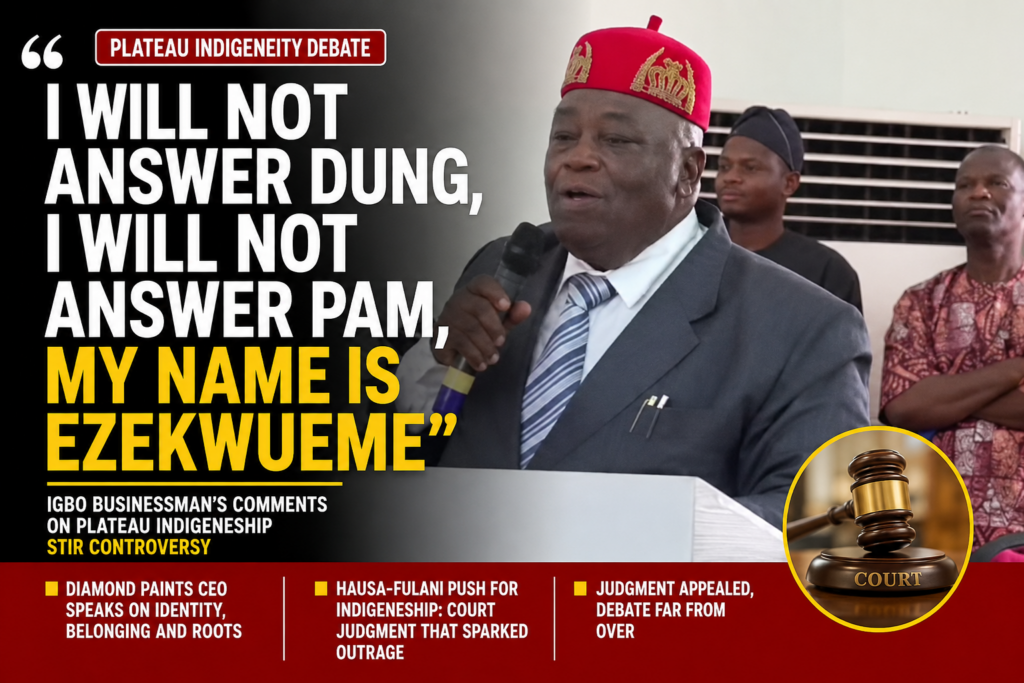
Prominent Jos-based businessman and Chairman of Diamond Group Nigeria, Chief Okey Ezekwueme, has sparked widespread conversation after making candid remarks on the sensitive issue of indigenship in Plateau State, amid ongoing legal and political debates over who qualifies as an indigene.
Speaking at a recent public event, Chief Ezekwueme reaffirmed both his deep attachment to Plateau State and his unwavering Igbo identity.
“Plateau is the best place to live in Nigeria. I am a Plateau man because this is my home, but I am not an indigene. I will not answer Dung. I will not answer Pam. My name is Ezekwueme.”
His comments have since generated mixed reactions on social media, with many describing them as a refreshing expression of honesty, while others see them as reopening the longstanding national conversation on citizenship, identity and belonging.
Chief Ezekwueme, whose Diamond Group has operated in Plateau for decades and employs thousands of residents, explained that although he considers Plateau home, he does not believe embracing the state requires abandoning his ancestral Igbo identity.
His remarks come barely weeks after a Plateau State High Court judgment in the case involving Fatima Baba Akawu and Jos North Local Government Council, which held that a Hausa woman born and raised in Jos North and whose father was recognised by the court as an indigene could not be denied an indigene certificate solely because of her ethnic origin.
The court also questioned the practice of issuing “residence certificates” instead of certificates of indigeneity.
The judgment immediately triggered intense controversy across Plateau State. Indigenous organisations, including the Plateau Initiative for Development and Advancement of the Natives (PIDAN), rejected the ruling, arguing that it could fundamentally alter the constitutional and historical meaning of indigeneity in Plateau.
They subsequently filed an appeal, insisting that the decision should not be interpreted as granting automatic indigene status to every long-term resident or person born in the state.
Former Plateau State Governor Jonah Jang also publicly opposed the judgment, warning that the ruling touches one of the state’s most delicate issues and should be resolved through the appellate courts.
Against this backdrop, Chief Ezekwueme’s statement has attracted attention because, unlike some campaigners seeking formal indigene status, he appeared to draw a distinction between belonging and ancestral identity.
His message suggests that one can proudly identify Plateau as home, contribute to its development, and still retain one’s ethnic heritage without demanding a change of identity.
For many observers, that position reflects the reality of thousands of Nigerians who have spent their entire lives outside their ancestral states but continue to maintain their cultural roots.
However, constitutional experts note that the broader question of indigeneity remains unresolved.
While the recent High Court decision has fuelled fresh debate, it has been appealed, meaning it is not the final judicial word on the matter.
The outcome of the appeal is expected to have significant implications for future discussions on citizenship, equal rights and indigeneity in Plateau State.
As Plateau continues to grapple with one of Nigeria’s most sensitive constitutional questions, Chief Okey Ezekwueme’s simple declaration — “I am a Plateau man, but I am not an indigene” — has added a new and thought-provoking perspective to an issue that remains far from settled.