PEPSA Begins Development of Landmark SBCC Guidelines, SOPs to Transform Environmental Governance
The Plateau State Environmental Protection and Sanitation Agency (PEPSA) has commenced the development of two landmark institutional frameworks aimed at strengthening environmental governance, improving sanitation service delivery and promoting sustainable behaviour change across Plateau State.
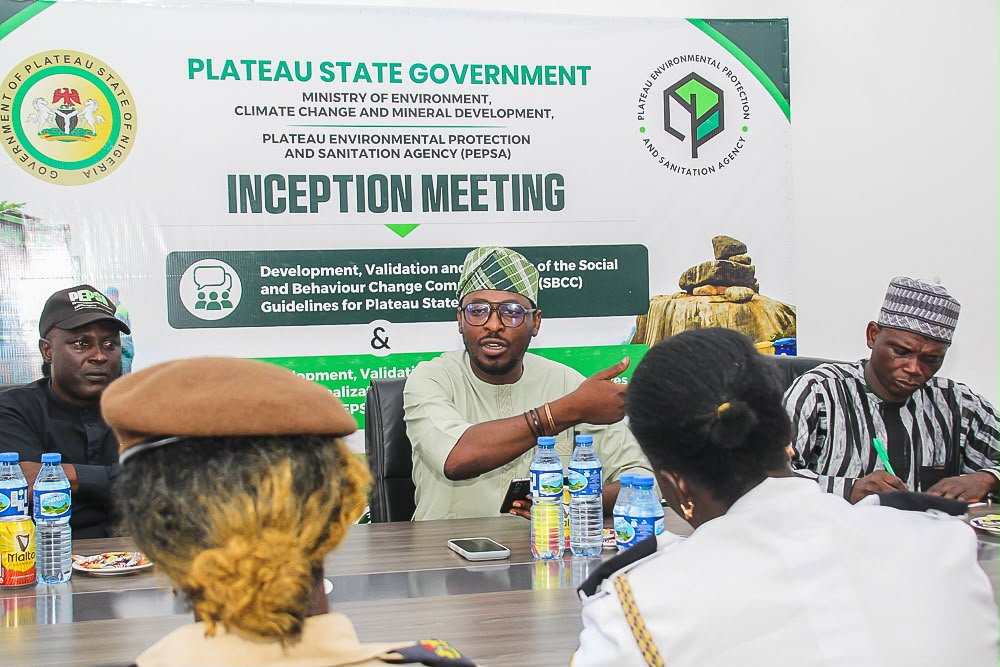
The initiative was officially launched during an inception meeting held at the Agency’s headquarters in Jos.
The exercise will produce the Plateau State Social and Behaviour Change Communication (SBCC) Guidelines and Standard Operating Procedures (SOPs) for PEPSA Operations, with the consultancy being led by Lead Technical Consultant, Herbert Gomagallah Daniel, alongside a multidisciplinary team of experts.
Speaking at the inception meeting, the Director General of PEPSA, Samuel Nathaniel Dapiya, described the exercise as a major institutional reform aimed at strengthening the Agency’s systems and improving service delivery.
Dapiya explained that the SBCC Guidelines would provide a practical framework for promoting positive sanitation behaviours among households, schools, businesses, markets, transport operators, institutions and communities across the state.
According to him, sustainable environmental sanitation cannot be achieved through infrastructure and law enforcement alone, stressing the importance of continuous public engagement and behavioural change.
He said the guidelines would help standardise sanitation messaging, strengthen collaboration among stakeholders, encourage community participation and ensure that communication strategies are inclusive and culturally appropriate.
SOPs to Strengthen PEPSA’s Operations
On the development of the Standard Operating Procedures, the PEPSA Director General said the framework would establish clear operational processes, improve accountability, define staff responsibilities, strengthen coordination across departments and preserve institutional knowledge.
Dapiya emphasised that the ultimate objective is to build an institution driven by effective systems rather than individuals.
He noted that clearly defined procedures would enable the Agency to maintain consistency in its operations while improving efficiency and accountability in the delivery of environmental sanitation services across Plateau State.
Consultant Explains Approach
Presenting the consultancy approach, Lead Technical Consultant, Herbert Gomagallah Daniel, said the assignment would adopt a participatory and evidence-based process.
He explained that the process would involve consultations with PEPSA management, technical staff, field officers, local government representatives, development partners and other relevant stakeholders.
Daniel said the project would also incorporate staff capacity development, implementation tools, monitoring and evaluation frameworks as well as validation processes designed to ensure ownership and sustainability.
He explained that while the SBCC Guidelines would provide a unified framework for transforming sanitation into a shared social responsibility, the SOPs would simplify workflows, improve coordination, strengthen accountability and establish practical standards for operational efficiency across the Agency.
Towards Better Environmental Governance
Upon completion, the two frameworks are expected to strengthen PEPSA’s institutional capacity, improve coordination with key stakeholders and enhance public confidence in the Agency’s operations.
The initiative is also expected to provide a practical model for environmental sanitation and behaviour change communication that could serve as a reference beyond Plateau State.
The development of the frameworks aligns with the Plateau State Government’s commitment to strengthening environmental governance, improving public health, promoting sustainable sanitation practices and advancing the objectives of Sustainable Development Goal 6 (SDG 6), which focuses on clean water and sanitation for all.
With the initiative, PEPSA is positioning institutional reform, public engagement and sustainable behavioural change at the centre of Plateau State’s environmental sanitation strategy.