
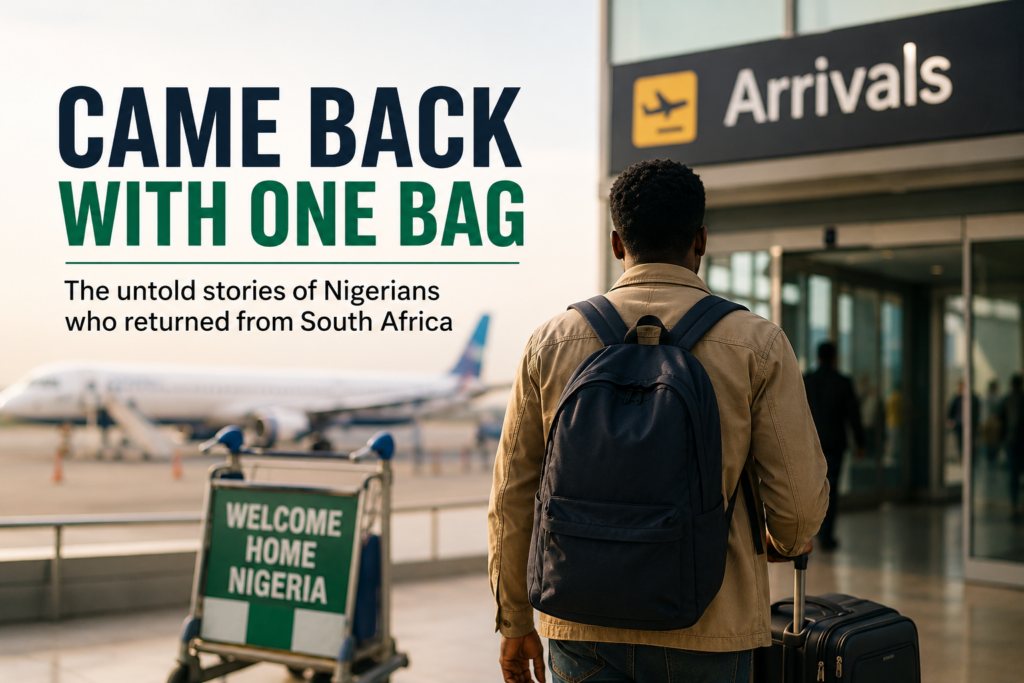
Saturday Special: “I Came Back With One Bag” – The Untold Stories of Nigerians Who Returned From South Africa
When the Air Peace aircraft touched down at the Murtala Muhammed International Airport in Lagos, the applause inside the cabin was not for a successful journey.
It was for survival.
Some passengers cried quietly. Others simply stared through the windows, trying to process the reality that they were home, not because they had achieved their dreams abroad, but because they had escaped with their lives.
For many Nigerians who recently returned from South Africa, homecoming came with mixed emotions: relief, disappointment, uncertainty, and hope.
Following renewed anti-immigrant protests and xenophobic attacks in parts of South Africa, hundreds of Nigerians chose voluntary repatriation, while more than 1,000 reportedly registered to return.
The Dream That Began With Hope
Like thousands of young Africans, many Nigerians crossed into South Africa believing they were travelling toward opportunity.
Some became mechanics.
Others opened barber shops, salons, grocery stores and restaurants.
A few found work in construction, security and transport.
For years, they sent money home, paid school fees for younger siblings and built houses for their parents.
Then everything changed.
As economic hardship deepened in South Africa, immigrants increasingly became targets of blame for unemployment, crime and pressure on public services. Anti-immigration demonstrations intensified in 2026, creating fresh fears among many foreign nationals.
“We Slept With One Eye Open”
Several returnees have described living under constant fear before deciding to leave.
Some said they avoided going out after dark.
Others closed their businesses for weeks because customers had disappeared and rumours of attacks spread rapidly through immigrant communities.
One returnee told journalists that renewing legal documents became almost impossible, leaving many trapped between bureaucracy and insecurity.
Others spoke of harassment, discrimination and uncertainty despite having lived in South Africa for years.
Many arrived in Nigeria carrying only one suitcase.
Their shops, furniture and years of investment remained behind.
The Long Flight Home
In June 2026, the Federal Government, working with Nigerian officials in Pretoria and local partners, began receiving batches of returnees.
Air Peace once again played a major role in transporting Nigerians back home, continuing a humanitarian tradition the airline became known for during earlier evacuation exercises.
Government officials assured returnees that their safety and dignity remained a national priority.
Yet stepping onto Nigerian soil solved only one problem.
The bigger question remained:
What next?
Returning To The Same Economy They Left.
Many migrants admitted they left Nigeria years earlier because jobs were scarce.
Ironically, they returned to face an economy still struggling with inflation, unemployment and rising living costs.
Some have moved in with relatives.
Others are attempting to restart businesses from scratch.
Experts warn that successful reintegration requires more than transportation home, it requires access to skills, finance and employment opportunities.
Without these, returnees may remain vulnerable despite their safe return.
A Lesson Beyond Borders
The story of Nigerian returnees is not simply about South Africa.
It is about the difficult choices millions of young Africans make every year.
Many leave home not because they dislike their countries, but because they hope to find dignity through work.
Unfortunately, migration does not always guarantee security.
Every country has its own economic pressures, immigration laws and social tensions.
The experiences of these returnees remind us that success abroad often comes with risks rarely shown on social media.
Hope After Heartbreak
Despite everything they endured, many returnees say they are determined to rebuild their lives.
Some hope to start businesses.
Others want vocational training.
Many simply want another chance.
One message echoed repeatedly among returnees interviewed after arriving in Lagos:
“There is no place like home.”
Perhaps the greatest lesson from their journey is that resilience does not end when a dream collapses.
Sometimes, it begins the moment the plane lands back home.