


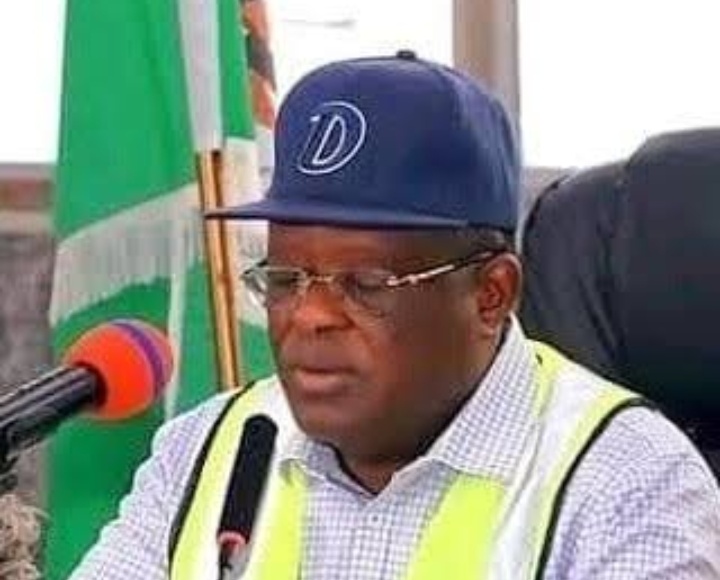
2027 Presidency: Umahi’s ‘Not Igbo Turn’ Comment Sparks Controversy
Minister of Works and former Ebonyi State Governor, David Umahi, has triggered fresh debate over the 2027 presidential contest after saying that it is not yet the turn of the Igbo to produce Nigeria’s president.
Umahi made the statement in Benin, Edo State, while speaking about the Federal Government’s infrastructure projects and defending President Bola Tinubu’s administration against criticism.
The minister was also responding to comments comparing his political record with that of former Anambra State Governor and 2027 presidential candidate of the Nigeria Democratic Congress (NDC), Peter Obi.
Umahi said he took time to consider the basis of claims that Obi was superior to him, questioning whether such comparisons were based on family background, intellectual credentials, political records or contributions to the South-East.
More Read

“When that guy said that Peter Obi is not my match, it took me 10 minutes to think about it,” Umahi said.
He subsequently addressed the long-running argument over the South-East’s quest to produce a Nigerian president.
“What we are saying is that it’s not the turn of the Igbo yet,” he said.
According to the minister, the South-East would eventually have its opportunity, but he believes the current political period belongs to President Tinubu.
More Read
“I want to be president, but it’s not yet our turn. It’s the turn of President Bola Tinubu,” Umahi stated.
He also called on supporters of the Tinubu administration to highlight what he described as the President’s achievements across the South-South, South-East and other parts of the country.
“We are saying that the president has done very well. In South-South, in South-East and in the entire geopolitical zone, he deserves continuity, he deserves support,” he said.
The ‘turn’ argument
Umahi’s remarks have reopened a broader national debate over whether Nigeria’s presidency should be viewed through an informal rotational arrangement among geopolitical zones or primarily through constitutional electoral competition.
Supporters of the South-East’s rotation argument point to the fact that the zone has not produced a president since the beginning of the Fourth Republic in 1999.
More Read
Others, however, argue that Nigeria’s Constitution does not establish a formal rotational arrangement for the presidency and that the office is ultimately determined through elections.
The disagreement has become particularly prominent ahead of the 2027 presidential election, with Peter Obi among the political figures seeking the presidency.
Umahi’s statement is therefore likely to remain part of the political conversation in the South-East and beyond as political parties and aspirants intensify preparations for 2027.
Why the statement matters
Beyond the immediate disagreement between Umahi and Obi’s supporters, the minister’s position touches on a longstanding question in Nigerian politics: should political power be distributed according to an informal principle of rotation, or should every presidential contest be decided primarily by candidates, parties, voters and constitutional rules?
The issue is particularly sensitive in the South-East, where the question of presidential inclusion has remained a major political concern since the return to democratic rule in 1999.

Headlineswave.ng reports that the 2027 presidential contest is already generating intense debate over zoning, competence, political inclusion and the records of the major contenders, with the South-East question expected to remain an important part of the conversation.