

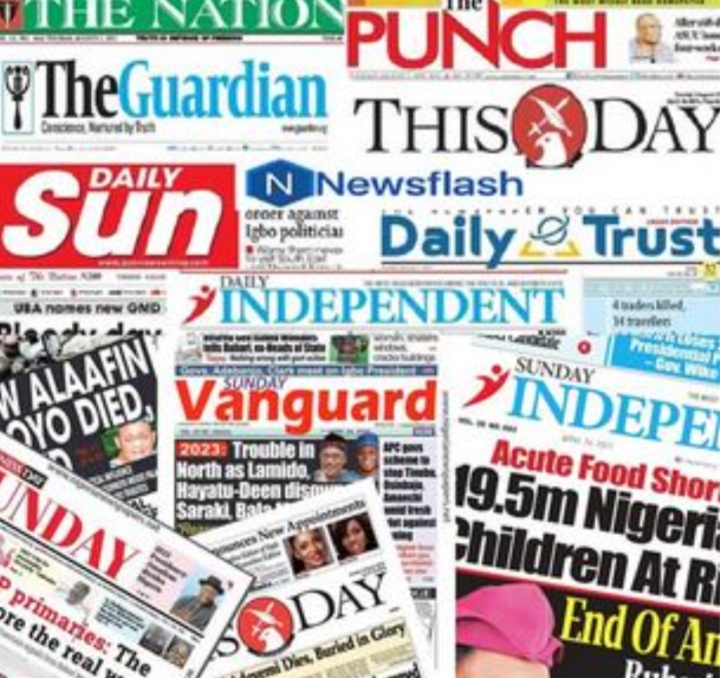
Top News Headlines For The Week That Was
Nigeria experienced another eventful week, with security concerns, political violence, electoral preparations, economic decisions and questions of public accountability dominating the national conversation.
From the deadly boat accident in Bayelsa State and fresh attacks in Plateau State to the growing political tensions ahead of the 2027 general elections, the week offered a sobering picture of the challenges confronting the country.
The political atmosphere also intensified as opposition leaders continued positioning themselves for the next presidential election, while the Independent National Electoral Commission (INEC) stepped up preparations for the electoral process.
More Read
On the economic front, government interventions in agriculture, banking and consumer protection attracted attention, even as Nigerians continued to demand tangible improvements in their living conditions.
Headlineswave presents its selection of the 10 major news stories that shaped the week.
1. At least 40 killed in fresh attacks across Plateau State as insecurity worsens
Friday, November 27 | Security
More Read
Plateau State was again in the national headlines following reports that at least 40 people had been killed in fresh attacks across different communities in the state over a period of three weeks.
According to reports published by TheCable, the victims included farmers, herders, women, youths, children and security personnel.
The attacks came amid continuing tensions between farming and herding communities, raising renewed concerns about the deteriorating security situation in parts of the state.
The development represents another painful chapter in Plateau’s prolonged struggle with communal violence and recurring attacks on vulnerable communities.
Why it matters
The protection of lives and property remains the most fundamental responsibility of government. Plateau residents deserve lasting security, not repeated condemnations after every attack. Government must strengthen intelligence gathering, prevent attacks and ensure that perpetrators are brought to justice.
More Read
2. Bayelsa boat tragedy: Death toll rises to 29 as Tinubu approves ₦250 million for victims’ families
Sunday, November 22 | National tragedy
The country was thrown into mourning following a deadly boat accident in Southern Ijaw Local Government Area of Bayelsa State.
The boat, carrying mourners travelling to a funeral, capsized at the Oweikorogha/Otuan River Junction on Friday, November 20.
By Sunday, Governor Douye Diri disclosed that the death toll had risen to 29, while more than 50 passengers survived.
President Bola Tinubu subsequently approved ₦250 million in support for affected families and directed stricter enforcement of safety standards on inland waterways.
Vice-President Kashim Shettima visited the state, met survivors and conveyed the Federal Government’s condolences.
The tragedy renewed concerns about overloading, mechanical defects, the absence of life jackets and poor enforcement of waterway safety regulations.
Why it matters
Nigerians should not have to risk their lives simply because they depend on waterways for transportation. Compensation is welcome, but effective regulation and enforcement are necessary to prevent future tragedies.
3. Political violence: Reps consider emergency intervention in Delta as police confirm attack on Obi’s supporters in Edo
November 25–26 | Politics and security
Political violence became one of the most disturbing developments of the week as attacks involving opposition political activities raised concerns about the safety of the 2027 electoral process.
In Delta State, a violent confrontation at a political gathering involving former Deputy Senate President Ovie Omo-Agege of the Nigeria Democratic Congress reportedly left six people dead.
The House of Representatives subsequently urged President Tinubu to consider invoking constitutional emergency powers if the situation escalated into an actual or imminent breakdown of public order.
In neighbouring Edo State, the police confirmed an attack on NDC supporters during political activities associated with Peter Obi’s visit to Benin City. One person was reported injured.
The police announced investigations into the incidents, while the conflicting accounts surrounding responsibility for the Delta violence remained a subject of concern.
Why it matters
Democracy cannot survive where political participation becomes dangerous. The government must protect opposition supporters just as it protects those of the ruling party. No Nigerian should lose their life for supporting a political candidate.
4. INEC establishes AI division as preparations for 2027 elections intensify
November 26–28 | Electoral reforms
The Independent National Electoral Commission featured prominently in the week’s political developments following reports that it had established an artificial intelligence division to tackle election misinformation.
The initiative is intended to strengthen the commission’s capacity to identify and respond to misleading information, including digitally manipulated content capable of influencing voters.
INEC also came under renewed scrutiny over the integrity of its voter database, following concerns raised by lawmakers about the quality of electoral records.
On Saturday, November 28, the commission conducted a planned test of its election result-transmission network at selected polling units as part of preparations for the 2027 general elections.
The commission’s preparations are taking place against the background of growing political tensions and concerns about the safety of election personnel.
Why it matters
Technology can strengthen elections, but it cannot independently guarantee credibility. INEC must demonstrate transparency, accuracy, impartiality and accountability at every stage of the electoral process.
5. Tinubu approves ₦100 million and houses for families of 25 NAF aircraft crash victims
Thursday, November 26 | National security and welfare
President Bola Tinubu announced a major support package for the families of the 25 people who died in the Nigerian Air Force NAF 931 aircraft crash in Igbokoda, Ondo State, on October 5, 2026.
At a memorial service and wreath-laying ceremony at the National Military Cemetery in Abuja, the President announced ₦100 million in financial support and a three-bedroom flat in Abuja for each bereaved family.
The victims included military personnel and civilians aboard the aircraft.
Tinubu also promised a thorough investigation into the circumstances surrounding the accident and pledged improvements in military and civilian aviation safety standards.
The Chief of the Air Staff, Air Marshal Sunday Kelvin Aneke, assured Nigerians that the Air Force would conduct a comprehensive and transparent investigation.
Why it matters
The welfare of military personnel and their families deserves serious attention. However, beyond compensation, Nigerians must receive answers about the circumstances of the crash and the measures being taken to prevent a recurrence.
6. NAFDAC destroys ₦22.73 billion worth of fake and substandard products
November 22–23 | Public health and consumer protection
The National Agency for Food and Drug Administration and Control (NAFDAC) disclosed that it destroyed fake, falsified, substandard and other unwholesome products valued at approximately ₦22.73 billion between January and August 2026.
The agency also reported 52 arrests, 5,542 enforcement activities, 213 raids, 821 products seized, 179 premises shut and 221 sanctions during the eight-month period.
The enforcement campaign reflects continuing efforts to tackle counterfeit medicines, unsafe food products, unregistered cosmetics and other dangerous consumer goods.
In another development reported towards the end of the week, NAFDAC shut down Zuba International Market in Abuja after uncovering counterfeit and unwholesome products worth more than ₦300 million.
Why it matters: Fake medicines and unsafe consumer products constitute a serious threat to public health. Regulatory agencies must sustain enforcement and ensure that those responsible face the law.
7. Atiku dismisses withdrawal rumours as opposition political realignment gathers momentum
November 22–27 | 2027 politics
Former Vice-President Atiku Abubakar dismissed reports that he had withdrawn from the 2027 presidential race, insisting that he remained in the contest.
The development came amid growing discussions about opposition cooperation and the possibility of a common political front against President Bola Tinubu.
Peter Obi, the presidential candidate of the Nigeria Democratic Congress, also remained at the centre of political conversations following his activities in Edo State and continuing mobilisation ahead of the next election.
Reports indicated that opposition figures, including Atiku, Obi and Seyi Makinde, were expected to meet in Abuja to explore the possibility of a common front.
The discussions reflect the continuing search for an effective opposition strategy ahead of 2027, although the different political ambitions and party platforms present significant challenges.
Why it matters
The ability of opposition parties to build a credible alternative will be one of the defining factors in the 2027 elections. Nigerians need a contest based on ideas, policies and competence rather than personality conflicts.
8. Tinubu approves ₦1.5 trillion recapitalisation for Bank of Agriculture, commits ₦450 billion to agriculture
Sunday, November 22 | Economy and food security
President Tinubu announced a major intervention in agricultural financing, including a reported ₦1.5 trillion recapitalisation of the Bank of Agriculture.
The administration also highlighted approximately ₦450 billion in agricultural financing intended to support food production and smallholder farmers.
The measures are part of the government’s efforts to strengthen agricultural productivity, improve access to financing and address food security challenges.
The announcements came at a time when the cost of food remains a major concern for Nigerian households and businesses.
Why it matters:
Nigeria’s agricultural potential remains enormous, but financing announcements must translate into affordable credit, improved access to inputs, better storage facilities and higher productivity. The real test is whether farmers and consumers will feel the impact.
9. ASUU threatens fresh nationwide strike over unpaid salaries from 2022 strike
The Academic Staff Union of Universities began mobilising its branches for a possible indefinite nationwide strike over outstanding salaries withheld from lecturers following the 2022 industrial action.
The union’s position raised fears of another disruption to academic activities in public universities.
The dispute reflects the continuing tensions between university lecturers and the Federal Government over labour agreements, welfare and the implementation of outstanding obligations.
The development renewed concerns about the stability of Nigeria’s public university system and the recurring disruption of students’ academic calendars.
Why it matters
Nigerian students cannot continue to bear the consequences of unresolved disputes between government and university workers. Sustainable funding, respect for agreements and constructive dialogue are essential to stabilising the education sector.
10. NAFDAC shuts Zuba International Market over ₦300 million counterfeit products
The Federal Capital Territory’s Zuba International Market came under regulatory scrutiny after NAFDAC uncovered counterfeit and unwholesome products valued at more than ₦300 million.
The operation involved the screening of over 160 shops and was conducted in collaboration with the Nigeria Police Force and the Department of State Services.
The agency said the operation formed part of its intensified campaign against the distribution of fake and unsafe regulated products, particularly ahead of the festive season.
The incident again exposed the scale of the counterfeit products challenge in Nigerian markets and the need for stronger regulatory oversight.
Why it matters
Consumers must be protected from traders who put profit above human life. Enforcement must continue beyond market closures, with proper investigations and prosecution of offenders.
The events of the week expose some of the country’s most persistent challenges: insecurity, political intolerance, economic hardship and weak institutional accountability.
The killings in Plateau and the violence associated with political activities in Delta and Edo states should concern every Nigerian. The country cannot afford an election season in which political ambition becomes a justification for intimidation, violence or murder.
The Tinubu administration must demonstrate that it can protect Nigerians irrespective of their political affiliations. Security agencies must act professionally, investigate attacks and ensure that perpetrators are brought to justice.
The Bayelsa boat tragedy also raises fundamental questions about regulatory enforcement. Nigerians should not continue to lose their lives through preventable accidents while authorities respond with condolences and financial assistance after the damage has been done.
On the economic front, government interventions in agriculture and banking are welcome, but Nigerians need to see their impact in food prices, employment opportunities, access to credit and improved purchasing power.
As 2027 approaches, the responsibility of political leaders is to present credible alternatives and engage citizens on the issues that matter.
Nigeria needs a democracy that protects dissent, an economy that works for ordinary citizens and institutions that are accountable to the people.
The message from this week’s developments is unmistakable: Nigerians deserve security, responsible leadership and measurable results, not another cycle of promises and excuses.
That was the week that was.
This weekly review was compiled by Headlineswave News Desk from reports published between Sunday, November 22 and Saturday, November 28, 2026, by established Nigerian and international media organisations, including Premium Times, TheCable, Channels Television, Punch, The Guardian, Reuters and official government sources.
Government statements, political claims and allegations have been attributed to their respective sources. Allegations remain allegations unless independently established.