

Fani-Kayode’s South Africa Row: Did Nigeria’s High Commissioner Cross the Line of Diplomatic Protocol.
Also Read Democrats Vow to Rein In Trump After Sweeping Midterm Victory, Take Control of Congress
A diplomatic disagreement between Nigeria and South Africa has drawn attention to the conduct expected of ambassadors after Nigeria’s High Commissioner to South Africa, Chief Femi Fani-Kayode, became involved in a public exchange with officials of the South African Presidency over his alleged exclusion from an official broadcast.
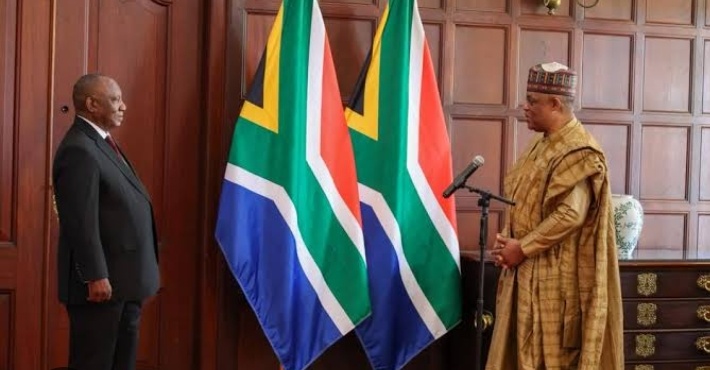
The controversy followed the presentation of Letters of Credence by Fani-Kayode and 14 other ambassadors to South African President Cyril Ramaphosa in Pretoria on Friday, November 13, 2026.
Following the ceremony, Fani-Kayode complained that the South African Presidency’s livestream had captured the introductions and speeches of the other ambassadors but failed to broadcast his own presentation.
More Read

According to his account, the livestream went off shortly before he delivered his address and resumed after he had finished speaking.
He reportedly raised the matter with President Ramaphosa, who directed officials to address the complaint.
However, South African presidential spokesperson Vincent Magwenya disputed aspects of Fani-Kayode’s account, explaining that the President had not intervened in the operations of the public broadcaster and that the Nigerian envoy had been directed to the appropriate official of the South African Broadcasting Corporation (SABC).
More Read

The disagreement subsequently escalated into a public exchange, with both sides questioning the conduct and communication of the other.
Did Fani-Kayode breach diplomatic protocol?
The controversy raises an important question about the boundaries of diplomatic engagement and the responsibilities of an ambassador representing a foreign government.
Under Article 41 of the 1961 Vienna Convention on Diplomatic Relations, diplomats are required to respect the laws and regulations of their host country and refrain from interfering in its internal affairs.
The convention also provides that official business entrusted to a diplomatic mission should be conducted with or through the receiving country’s Ministry of Foreign Affairs or another agreed government channel.
Although the convention does not expressly prohibit diplomats from making public statements or raising complaints through the media, established diplomatic practice generally favours discreet engagement, restraint and the use of official channels when disagreements arise.
More Read

Consequently, Fani-Kayode’s decision to take the disagreement into the public space raises questions about whether the matter could have been handled differently without escalating tensions between the two countries.
It is important, however, not to confuse a controversial diplomatic approach with an established violation of international law. The available facts do not, by themselves, establish that Fani-Kayode breached the Vienna Convention.
Was Nigeria deliberately sidelined?
Beyond the argument over diplomatic conduct, another important question remains unanswered: why was Nigeria’s High Commissioner allegedly omitted from the original livestream?
If the broadcast interruption occurred as Fani-Kayode described, the South African authorities and broadcaster owe the public a satisfactory explanation.
The South African Presidency subsequently published a separate video containing Fani-Kayode’s address. The SABC also explained that its editorial coverage and the Presidency’s livestream arrangements were separate matters.
These developments make it necessary to distinguish between an established technical or broadcasting incident and the allegation that Nigeria was deliberately singled out.
There is currently insufficient publicly established evidence to conclude that the omission was an intentional act of discrimination against Nigeria.
Nigeria’s diplomatic image at stake
The disagreement is particularly significant because ambassadors are not merely representatives of their personal interests. They embody the sovereignty, dignity and diplomatic interests of their countries.
An ambassador has every right to protest perceived disrespect towards his country. However, how such grievances are communicated can be just as important as the grievances themselves.
In a relationship involving two major African countries, disagreements should ideally be resolved through diplomatic engagement rather than public exchanges that risk deepening tensions.
South Africa also has a responsibility to ensure that representatives of other countries receive appropriate courtesies and that legitimate complaints are addressed transparently.
Ultimately, the issue goes beyond Fani-Kayode’s personal disagreement with South African officials. It raises broader questions about diplomatic discipline, national dignity and the manner in which African countries manage disagreements among themselves.
The question Nigerians must consider is this: Did Fani-Kayode’s public response advance Nigeria’s diplomatic interests, or could the same protest have achieved more through established diplomatic channels?
This report examines the competing accounts of Nigeria’s High Commissioner, the South African Presidency and the SABC, alongside the provisions of the 1961 Vienna Convention on Diplomatic Relations.
The allegation of deliberate exclusion remains disputed, and no definitive finding of a diplomatic law violation has been established.
Source: South African Presidency, South African Broadcasting Corporation (SABC), TheCable, Punch and the Vienna Convention on Diplomatic Relations (1961).