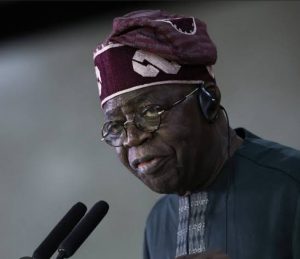



Rufai Oseni sings ‘On Your Mandate We Shall Stand’ for Tinubu on Arise TV days after Adeleke’s Osun governorship election victory.
The anchor’s sarcastic rendition comes amid questions over Governor Adeleke’s decision to support Tinubu after Osun voters delivered a strong electoral verdict against the APC.
But Oseni was not singing it as a campaign anthem. He was being sarcastic.
The moment came during a discussion involving a Special Adviser on Political Matters to Governor Ademola Adeleke, following the governor’s declaration that he would support President Tinubu’s 2027 re-election bid even as a major stakeholder and member of the Accord Party. And therein lies the irony that appeared to provoke Oseni’s reaction.
The Osun Mandate That Changed the Conversation

Just days earlier, the people of Osun State had gone to the polls and handed Adeleke a decisive re-election victory on the platform of the Accord Party.
Adeleke polled 511,067 votes, defeating the APC candidate, Bola Oyebamiji, who scored 409,487 votes.
The result gave Accord Party its first governorship victory in Nigeria.
More Read

Recall that he election itself had been surrounded by intense political tension, allegations and counter-allegations, with the APC and opposition camps sharply divided over the conduct and credibility of the process.
For many opposition voices and Nigerians who followed the election, Adeleke’s victory was interpreted as a powerful statement by Osun voters — a refusal to hand the state back to the APC.
Indeed, reports following the election described the outcome as generating praise from opposition groups, while the APC indicated that it was considering its legal options.
The political symbolism was therefore enormous.
Osun voters had just spoken.
And they had spoken through an Accord candidate against the APC.
Then Came Adeleke’s 2027 Declaration
Against that backdrop,
More Read

Adeleke’s decision to support Tinubu for the 2027 presidential election introduced an entirely different dimension to the story.
The governor and Accord Party leadership have been reported as backing Tinubu for 2027, with Adeleke subsequently reaffirming that position.
That development immediately raises a question:
What exactly was the message delivered by the Osun electorate when it voted overwhelmingly for Adeleke against the APC — and how does that mandate relate to the governor’s decision to support the same political establishment his voters had just rejected at the state level?
That appeared to be the uncomfortable question lurking behind Oseni’s reaction.
Why Rufai Sang the Song
It was at that point that Oseni’s sarcasm became unmistakable.
He sang:
“On Your Mandate We Shall Stand…”
The irony was difficult to miss.
The song is associated with Tinubu’s political movement, but Oseni’s rendition appeared to turn it into a sarcastic commentary on the political situation.
In essence, the message appeared to be: …If political arrangements have already been made and everybody has agreed to support Tinubu, then why continue scrutinising the politics? Let us simply sing “On Your Mandate We Shall Stand.”
Oseni appeared to be questioning whether the political interests of the people who had just voted in Osun were being overshadowed by political calculations taking place after the election.
Did Osun Voters Vote for This?
That is the central question.
The people of Osun had just given Adeleke a fresh mandate after an election that had become a major national political test.
The victory was celebrated by those who saw it as evidence that voters could resist the political machinery of the ruling party and determine their own political direction.
But barely had the dust settled than the conversation shifted from the people’s mandate in Osun to political support for the 2027 presidential election.
That contrast is what makes Oseni’s sarcastic song particularly powerful.
It invites Nigerians to ask whether electoral mandates should be interpreted strictly as personal mandates for politicians — or whether they also carry a broader political message from the electorate.
Adeleke’s Victory Is Now Bigger Than Osun
The 2026 Osun election has already become part of the national conversation about 2027.
The APC suffered defeat in a state where the contest had attracted enormous national attention, while Adeleke emerged with a significantly wider winning margin than in his previous governorship victory.
The opposition has consequently viewed the result as evidence that Nigerians can defeat the ruling party at the ballot box, while the Tinubu camp appears keen to maintain political relations with Adeleke following his victory.
That makes Adeleke’s post-election political positioning especially significant.
And it explains why Oseni’s seemingly playful rendition of a campaign song carried a much more serious political message.
The question is no longer simply who won Osun. The question is what the Osun mandate means — and whether the voice of the voters will remain at the centre of the political calculations now unfolding ahead of 2027.
Headlinewave monitored the discussion on Arise TV’s Tuesday edition of the Morning Show.
Headlinewave reports events based on available statements, interviews and verifiable sources.
Where a report involves political claims, interpretations or opinions, such claims are attributed to the individuals who made them and should not be interpreted as independently established facts unless expressly verified.