

Peter Obi at 66: Nigeria Must Move Beyond Celebration, Confront Poverty and Insecurity
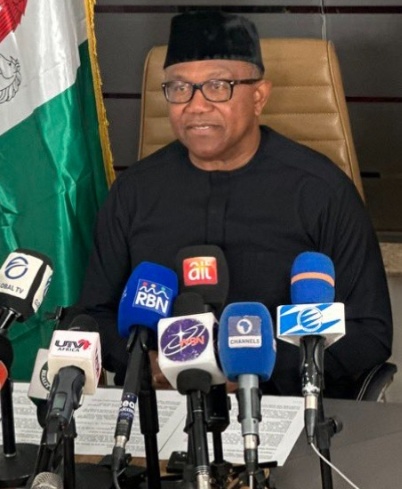
Presidential candidate of the Nigeria Democratic Congress (NDC), Peter Obi, has used Nigeria’s 66th Independence Anniversary to call for sober national reflection, saying the country’s enormous human and natural resources have not translated into the prosperity, security and human development expected by citizens.
In his Independence Day address titled “Nigeria at 66: Looking Back, Looking Forward,” Obi said Nigeria’s anniversary should not be reduced to celebration but should provide an opportunity for citizens and leaders to examine the country’s current situation and determine how to move forward.
He identified poverty, insecurity, hunger, out-of-school children, unemployment, drug abuse, maternal and infant mortality and low life expectancy among the major challenges confronting the country.
Obi argued that Nigeria’s fundamental problem was not a lack of resources but the failure to convert those resources into human development, productivity, security and shared prosperity.
More Read

He also spoke about his recent visit to Sokoto State with Senator Rabiu Kwankwaso, during which they visited the Internally Displaced Persons camp at Ramin Kura in Sokoto metropolis.
According to him, the condition of displaced women and children at the camp underscored the human cost of insecurity in the country.
Obi’s Independence Day address
Nigeria at 66: Looking Back, Looking Forward
Fellow Nigerians,
Today we mark the sixty-sixth anniversary of our independence. It ought to be a day of celebration and thanksgiving to God Almighty for the gift of life and for the immense blessings He has bestowed on our nation—our diversity, our abundant human and natural resources, our vast agricultural potential, and the relative absence of devastating natural disasters.
It should also be a day of appreciation and patriotism: a day to remember our founding fathers and all those who made selfless, and in many cases supreme, sacrifices for the birth, survival and growth of our dear nation. We must acknowledge the efforts of past and present leaders who have laboured, however imperfectly, to build a better Nigeria.
Yet independence anniversaries must never be reduced to mere celebration. They are moments for honest national reflection. We must look back, examine where we stand today, and ask ourselves whether we are moving in the direction our founding fathers envisioned.
In national planning and strategy, every serious nation must continually ask three fundamental questions:
More Read
Where are we today?
Where do we want to be?
How do we get from where we are to where we want to be?
These questions are especially urgent now. Despite the enormous promises made by the APC-led government in 2023, our nation continues to face deepening challenges across virtually every critical sector of national life.
Today we stand before the world as a nation:
With an extraordinarily large population living in poverty and severe hardship; over 140M.
With one of the largest populations of out-of-school children in the world; over 18M.
Where insecurity, terrorism, banditry and kidnapping continue to threaten lives and livelihoods, just recently 37 young Nigerians in their productive age lost their lives.
Where millions of Nigerians struggle with hunger and food insecurity; over 40M Nigerians will be in extreme hunger by the end of 2026.
With unacceptably high rates of infant and maternal mortality; Nigeria today is the worst place to be born.
Where youth unemployment and underemployment remain alarmingly high; over 35M.
Where drug abuse and substance misuse increasingly threaten our young population; today 14% as against global average of 6%.
Where life expectancy remains among the lowest globally, today 54 years against global average of 74 years.
And the list goes on.
This reality demands serious, sober and honest reflection. Socrates taught that “the unexamined life is not worth living.” By the same principle, an unexamined nation cannot successfully chart its future.
We must therefore ask ourselves: Are we cursed, or have we become the curse through the choices we have made and the failures we have tolerated?
The answer cannot be that Nigeria is cursed. We are a nation immensely endowed and blessed. Our greatest problem is not a lack of resources; it is the failure to convert our enormous resources into human development, productivity, security and shared prosperity.
Only yesterday, Senator Rabiu Kwankwaso and I returned from a two-day visit to Sokoto State. We held extensive consultations with people from different parts of the state on insecurity, out-of-school children, poverty, youth unemployment, drug abuse and other challenges confronting our people.
In concluding the visit, we went to the Internally Displaced Persons camp at Ramin Kura within Sokoto metropolis.
What we saw was deeply troubling. Thousands of women and children live in deplorable conditions, displaced from their homes and deprived of the basic necessities of life. Many of the children have no access to education. Mothers and children have limited access to basic healthcare.
These are Nigerians who should be living in their communities, going to school, farming their land, conducting their businesses and contributing to the economy. Instead, they live as displaced persons in their own country.
What Obi said next
Obi continued by arguing that the situation at Ramin Kura reflected the suffering experienced in different parts of Nigeria. He questioned the failure of political leadership to adequately address the conditions facing ordinary Nigerians and said the situation must change.
He then shifted from his assessment of the country’s problems to what he described as a message of hope, determination and responsibility, declaring that a new Nigeria was possible.
He said that, if elected President, he would seek to make governance measurable and accountable, with greater emphasis on the welfare and productivity of Nigerians.
He promised that Nigerians would begin to see what he described as the tangible impact of effective leadership within his first year in office.
On security, Obi said his administration would confront insecurity with the aim of allowing farmers to return to their farms, children to return to school, businesses to operate freely and families to live without fear.
He also said Nigerians displaced by insecurity should be able to return safely and with dignity to their communities rather than remain indefinitely in IDP camps.
On the economy, he said Nigeria should move away from a consumption-driven model towards a productive economy capable of creating jobs, supporting agriculture and manufacturing, investing in human capital and expanding opportunities for young Nigerians.
He listed education, healthcare, security and productive enterprise as priorities that should be treated as foundations of national development rather than luxuries.
‘I will lead by example’
Obi also addressed his personal approach to leadership.
He said that, during a four-year presidential tenure, he would not spend his holidays outside Nigeria. Instead, he said he would use such periods to visit states including Zamfara, Borno, Kwara, Ebonyi and Ekiti, as well as other parts of the country.
He said the purpose would be to continue seeing Nigeria, understanding the experiences of Nigerians, listening to their concerns and witnessing their resilience.
He concluded by calling for a Nigeria that is secure, united and productive and where public resources are deployed for the public good.
He also urged Nigerians to demand accountability, stressing that the country’s future would require responsible leadership as well as citizens who refuse to accept failure as their destiny.
The address ended with a call to build what Obi described as a new and productive Nigeria, followed by a prayer for God’s blessing on the Federal Republic of Nigeria.
Headlineswave News Desk reviewed the published text of Peter Obi’s October 1, 2026 Independence Day address and compared its major claims and concluding commitments with reports by BusinessDay, Channels Television and other contemporary reports.