

Monica Lewinsky Was 22, Bill Clinton Was 49: The Scandal That Changed Her Life But Almost Cost Him Nothing
Read Also Democrats Vow to Rein In Trump After Sweeping Midterm Victory, Take Control of Congress
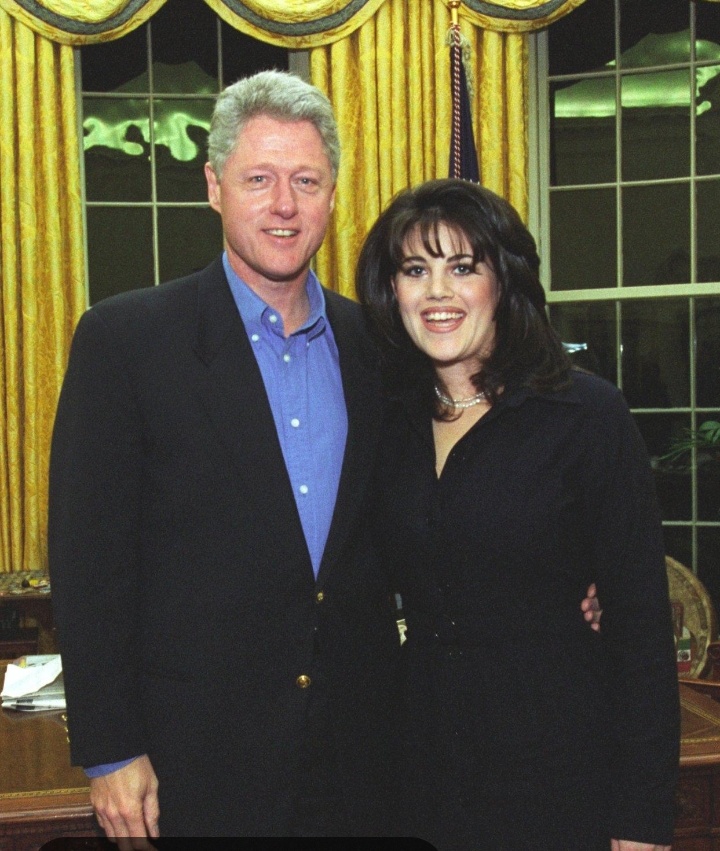
In November 1995, a 22-year-old college graduate working as an unpaid intern at the White House became involved in a relationship with the most powerful man in the world.
His name was Bill Clinton, then 49 and serving as President of the United States.
Her name was Monica Lewinsky.
What followed became one of the most sensational political scandals in American history. Nearly three decades later, the story remains a disturbing examination of power, accountability, media cruelty and the unequal consequences of scandal.
More Read

It is also a story about how a young woman’s identity became permanently attached to an episode that helped define a presidency but did not end it.
An intern, a president and an extraordinary imbalance of power
Monica Lewinsky arrived in Washington in the summer of 1995 after graduating from Lewis & Clark College. She secured an unpaid internship in the office of President Clinton’s Chief of Staff, Leon Panetta.By November, she had begun a sexual relationship with Clinton.
More Read

According to her testimony, the relationship involved nine in-person sexual encounters, some in and around the Oval Office, and continued intermittently until 1997.
Clinton was a married president with enormous political influence. Lewinsky was a young woman at the beginning of her professional life.
Although the relationship was described publicly as consensual, the enormous difference in age, authority and institutional power would later become central to discussions about responsibility and the treatment of young women in powerful workplaces.
In April 1996, Lewinsky was transferred from the White House to a position at the Pentagon.
It was there that she met Linda Tripp, a fellow government employee who would become one of the most consequential figures in the unfolding scandal.
The friend who secretly recorded her conversations
More Read

Lewinsky confided in Tripp, sharing details of her relationship with the president.
But behind the friendship, something else was happening.
On the advice of literary agent Lucianne Goldberg, Tripp began secretly recording telephone conversations in which Lewinsky discussed the affair.
The recordings eventually amounted to more than 20 hours.
Tripp handed the recordings to Independent Counsel Kenneth Starr, who was already investigating matters involving Clinton.
The tapes became a crucial part of the investigation, particularly because Lewinsky had signed an affidavit denying a sexual relationship with the president in connection with the Paula Jones sexual-harassment lawsuit.The situation was rapidly becoming a national political crisis.
The blue dress that changed everything
Among the most consequential pieces of evidence was a blue dress Lewinsky had kept.
Investigators eventually obtained the dress, which contained biological evidence linked to Clinton.
In August 1998, Clinton provided a blood sample for DNA comparison. The results matched the biological evidence on the dress.
The evidence made it increasingly difficult for the president to maintain his earlier denial.
But before that happened, Clinton had already made one of the most memorable televised denials in American political history.
On January 26, 1998, he stood before television cameras and declared:
“I did not have sexual relations with that woman, Miss Lewinsky.”
The statement became an enduring symbol of the scandal.
Months later, Clinton admitted that he had an inappropriate relationship with Lewinsky.
The president faced impeachment. Monica faced public humiliation.
The scandal became a global media spectacle.
Lewinsky was subjected to relentless ridicule, sexual shaming and public condemnation. Her private life became material for television jokes, newspaper headlines and political commentary.
She was labelled with deeply insulting descriptions, while her appearance, intelligence, character and motives were constantly questioned.
Clinton, meanwhile, faced impeachment proceedings over allegations of perjury and obstruction of justice.
On December 19, 1998, the House of Representatives impeached him.
However, on February 12, 1999, the Senate acquitted him. He remained in office and completed his second presidential term in January 2001.
The distinction is important: Clinton was politically wounded, impeached and internationally embarrassed, but he did not lose the presidency.
Lewinsky, on the other hand, struggled with the consequences of becoming one of the most recognisable and ridiculed women in the world.
A million-dollar interview and a lifetime of consequences
In 1999, Lewinsky sat down with renowned American television journalist Barbara Walters for an interview that attracted an enormous international audience.
She also explored commercial opportunities, including a book and a deal with weight-loss company Jenny Craig.
But financial opportunities did not erase the public humiliation or the difficulty of rebuilding a professional identity after becoming the subject of an international scandal.
For years, her name was routinely used as a punchline
The internet and social media would later provide her with another platform to discuss the experience, particularly the destructive consequences of public shaming and online harassment.
Over time, Lewinsky reinvented herself as a public speaker, producer and anti-bullying advocate.
In 2021, she served as an executive produ*: American Crime Story*, a television dramatisation of the scandal.
Her involvement was significant: she was no longer simply the subject of other people’s storytelling. She was participating in the telling of her own story.
Nearly three decades later, Lewinsky has a different message
In February 2025, Lewinsky revisited the scandal during an appearance on Alex Cooper’s Call Her Daddy podcast.
She argued that Clinton should have resigned or at least found a way to remain in office without lying and throwing a young woman who was just beginning her life under the bus.
Her comments reflected a perspective that has gained greater attention over the years: the question of how responsibility should be understood when a relationship involves such an enormous imbalance of institutional power.
Lewinsky also acknwhicj owledged that she should never have been placed in that position because of the power differential.
Her reflections were not simply about an old affair. They were about the consequences of how the affair was handled, how the public responded and how the burden of the scandal was distributed.
The bigger lesson: Power does not always come with accountability
The Clinton-Lewinsky scandal is more than a story about an affair between a president and a young intern.
It raises difficult questions about power, professional boundaries, personal responsibility, political survival and the media’s treatment of women.
Two people participated in the same relationship, but their lives followed remarkably different trajectories.
Clinton survived impeachment, completed his presidency and retained his place in American political history.
Lewinsky spent years fighting to be recognised as more than the young woman at the centre of a presidential scandal.
There is an important distinction between acknowledging personal responsibility and accepting that one individual should carry almost the entire burden of public disgrace.
In 2025, Lewinsky’s renewed reflections brought that distinction back into public conversation.
Perhaps the most enduring lesson is this: when power and vulnerability meet, responsibility must never be measured only by who suffers the loudest public consequences.
A scandal may last for months in the headlines, but its consequences can follow one person for a lifetime.
The president left office. The scandal never quite left Monica Lewinsky.

This feature is based on documented historical accounts of the Clinton-Lewinsky scandal, the independent counsel’s investigation, congressional impeachment proceedings and Monica Lewinsky’s February 2025 interview on the Call Her Daddy podcast.
The article distinguishes established historical events from Lewinsky’s later personal reflections.
Source references: TIME, The History Channel, The Washington Post and CNN.
Headlineswave News Desk