

NDC Questions Tinubu Government’s 30-Day Petrol Discount
The opposition party questions the sustainability of the Federal Government’s 30-day intervention, arguing that temporary fuel relief cannot reverse the economic hardship Nigerians have endured since subsidy removal.
The Nigeria Democratic Congress (NDC) has criticised President Bola Tinubu’s administration over its announcement of a 30-day petrol discount at Nigerian National Petroleum Company Limited (NNPC) filling stations, describing the intervention as “tokenism and deceit.”
The opposition party argued that the temporary measure would do little to address the wider economic difficulties Nigerians have faced since the removal of petrol subsidies in 2023.
The Federal Government announced the discount on Thursday, October 8, 2026, with public transport operators receiving priority under the arrangement.
More Read
Minister of Finance and Coordinating Minister of the Economy, Taiwo Oyedele, said the government intended to allow NNPC to sell petrol at cost during the initial 30-day period, stressing that the arrangement was not a return to the former subsidy regime.
NDC Questions Government’s Response to Fuel Hardship
Reacting to the announcement in a statement signed by its National Publicity Secretary, Osa Director, the NDC described the intervention as an inadequate response to the consequences of the subsidy removal.
More Read
The party maintained that the government should have anticipated the impact of the policy and introduced effective measures to protect households, workers and businesses from the resulting economic pressures.
It questioned what would happen to Nigerians whose businesses had collapsed or who had lost their jobs amid rising operating costs and declining purchasing power.
The party also expressed concern about the pressure on public healthcare, arguing that the economic consequences of government policies had compounded the difficulties faced by vulnerable citizens.
According to the NDC, a temporary reduction in petrol costs cannot, by itself, reverse the accumulated effects of rising transportation expenses and the increased cost of living.
Party Raises Questions Over Access to Discounted Petrol
The opposition party also questioned whether the NNPC retail network could adequately serve Nigerians nationwide during the 30-day period.
More Read

It warned that restricting the intervention to NNPC filling stations could limit access for motorists and transport operators who live far from participating outlets.
The NDC further raised concerns about the possibility of long queues and congestion at filling stations if demand significantly increased during the discount period.
However, the Federal Government has said public transport operators will receive priority under the arrangement. The precise size of the discount and the detailed implementation framework were not specified in the initial announcement.
The party argued that Nigerians needed a transparent explanation of how the scheme would work, who would benefit and what measures would follow when the initial 30 days expired.
NDC Accuses APC Government of Reversing Course
The NDC described the announcement as an attempt to reintroduce fuel subsidy indirectly, although the government has expressly rejected that characterisation.
Oyedele said the arrangement was intended to sell petrol at cost rather than restore a blanket subsidy.
The government also announced other proposed measures to cushion the impact of rising fuel prices, including negotiations over a ₦1,350-per-litre ceiling on petrol’s ex-gantry or landing cost, forward sales of crude oil to domestic refiners and additional support for vulnerable households.
The proposed ceiling refers to the ex-gantry or landing cost, not a guaranteed nationwide pump price. The government said the arrangement would be reviewed monthly.
Despite these proposals, the NDC insisted that the latest intervention raised questions about the government’s approach to managing fuel prices and the broader economy.
The party accused the All Progressives Congress (APC) administration of failing to provide adequate protection for Nigerians against the economic consequences of its policies.
NDC Projects Peter Obi as Alternative
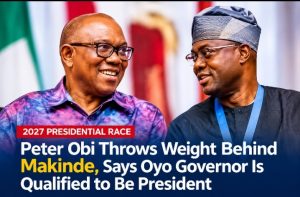
The opposition party used its reaction to reiterate its support for Peter Obi, whom it described as the alternative to the Tinubu administration.
According to the statement, the NDC believes Obi’s leadership would put Nigeria on a different economic path.
The party urged Nigerians to support Obi and other NDC candidates in the January 16, 2027 elections, presenting the forthcoming polls as an opportunity to seek a change in the country’s political leadership.
Its statement ended with the slogan, “A New Nigeria is POssible with Obi.”
What Happens After 30 Days?
Beyond the political exchanges, the central question for motorists, transport operators and households is whether the intervention will deliver measurable relief and whether that relief can be sustained.
The government says its measures are designed to reduce the immediate impact of petrol prices without returning to a blanket subsidy.
The NDC, however, argues that a 30-day discount is insufficient to address the wider economic pressures facing Nigerians.
The effectiveness of the intervention will depend on its implementation, the extent of the price reduction, the number of Nigerians who can access it and whether the anticipated benefits translate into lower transport fares and reduced costs for consumers.
For millions of households already struggling with rising living expenses, the more pressing concern is whether the initiative will provide meaningful relief beyond the filling station—and what happens when the 30-day period ends.
This report is based on the NDC’s statement and published reports of the Federal Government’s October 8, 2026 announcement.
The party’s criticisms and political claims are attributed to it, while the government’s stated position is presented separately.
Source: Nigeria Democratic Congress (NDC); Federal Government briefing.