

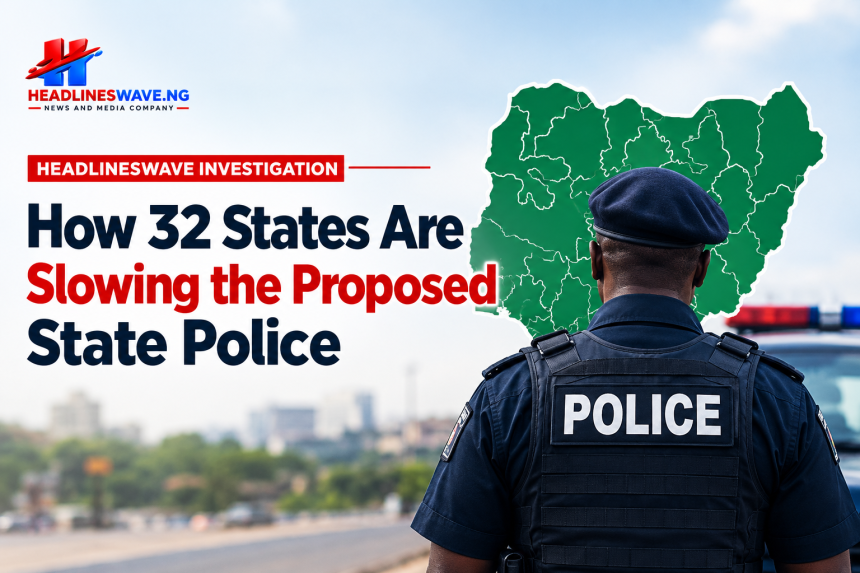
Headlineswave Investigation
Nigeria’s push to establish state police is facing a significant legislative hurdle, with only four of the country’s 36 state Houses of Assembly having formally approved the proposed constitutional amendment.
As of the latest findings reported on October 4, 2026, Edo, Osun, Oyo and Rivers had given their concurrence to the proposal, leaving 32 other states at different stages of the legislative process.
Some have commenced consideration. Others are studying the proposal or consulting stakeholders, while several Houses say they are yet to receive the bill from the National Assembly.
The slow pace raises an important question: How close is Nigeria to achieving the constitutional changes required to establish state police?
More Read

The 24-state hurdle
The National Assembly transmitted the proposed constitutional amendment to the 36 state Houses of Assembly on September 16, 2026, asking them to communicate their resolutions within 30 days.
However, the 30-day period is an administrative target, not a constitutional deadline.
More Read

Under Section 9 of the 1999 Constitution, an amendment requires the approval of at least two-thirds of the state Houses of Assembly.
That means 24 of the 36 states must approve the proposal.
With only four states having done so at the time of the latest assessment, another 20 state Houses must still give their formal approval before the constitutional threshold is reached.
South-West:
Some progress, but uneven
The South-West presents a mixed picture.
Osun and Oyo have approved the proposal, while Ondo and Ekiti have received the bill and are still studying it.
Ogun has constituted a committee to examine the proposed amendment.
Lagos has publicly endorsed state police and called for faster action, but its formal approval of the constitutional amendment transmitted by the National Assembly had not been publicly confirmed.
More Read

This distinction matters.
A state supporting the idea of state police in principle is not the same as its House of Assembly formally approving the constitutional amendment.
South-South moving faster
The South-South has recorded two formal approvals.
Rivers and Edo have endorsed the proposal, while Cross River has commenced consideration after the bill passed its First Reading.
Delta has confirmed receipt of the bill and is consulting stakeholders, while Bayelsa had yet to formally debate or vote on it.
The region therefore illustrates both sides of the debate: formal approval in some states and caution or consultation in others.
Northern states face delays
The legislative process appears slower across several Northern states.
Kano, Kwara, Kebbi, Taraba and Gombe reportedly said they were yet to receive the bill, meaning their Houses could not begin formal consideration.
Other states, including Yobe, Borno, Nasarawa, Zamfara and Sokoto, had received the proposal but had not yet approved it.
Bauchi has constituted a committee to examine the bill.
Plateau State, however, has commenced formal consideration.
The Plateau House of Assembly received the communication through Governor Caleb Mutfwang, after which the Majority Leader, Joseph Gokum, moved for consideration of the State Police Bill.
The motion was seconded by Matthew Sylvanus Kwarpo, and the Speaker, Naanlong Daniel, directed the Clerk to proceed with the First Reading.
South-East yet to record formal approval
The South-East has also yet to record a formal approval among the states covered in the report.
Anambra has not commenced debate, although the Speakers of the five South-East Houses have previously expressed support in principle for state police and agreed to work towards harmonising their legislative approaches.
Abia was expected to take a position when lawmakers resumed on October 6.
Enugu and Imo had yet to formally consider the proposal, while Ebonyi had confirmed receipt and promised accelerated consideration.
Why the delay matters
The debate over state police goes beyond whether states support or oppose the idea.
The proposed amendment would fundamentally change Nigeria’s policing architecture by providing for State Police Services while retaining the Nigeria Police Force as the Federal Police Service.
That raises important questions about funding, recruitment, training, command structures, accountability and the protection of citizens from political abuse.
State police could bring policing closer to communities and potentially improve intelligence gathering and rapid response. But without strong safeguards, critics fear that state-controlled police formations could become vulnerable to political influence.
These concerns make the constitutional amendment a major institutional decision, not merely another legislative exercise.
The numbers tell the story
The current position is straightforward:
36 states.
4 formal approvals.
24 required.
20 more approvals needed.
The proposed State Police reform is therefore still a considerable distance from clearing the constitutional hurdle.
The emerging picture does not necessarily show that 32 states are opposed to state police. Rather, it shows that 32 state Houses had not yet formally approved the constitutional amendment at the time covered by the latest report.
That distinction is important.
For Nigeria, where insecurity remains one of the country’s most pressing challenges, the speed and seriousness with which state legislatures handle the proposal could determine whether state police moves from a long-running national debate to an actual constitutional reality.
The State Police debate should not be reduced to a simple for-or-against argument.
Nigeria needs a policing structure capable of responding quickly to threats at the community level. But decentralising policing must come with clear constitutional safeguards, professional recruitment, independent oversight, adequate funding and strong mechanisms to prevent political misuse.
The responsibility now rests heavily on the state Houses of Assembly.
If state police is truly considered necessary for Nigeria’s security, the next step is for each legislature to receive, study, debate and transparently vote on the proposal.
Until then, the numbers remain a reminder of how far the reform still has to go.
This investigation is based on publicly reported positions of state Houses of Assembly and the constitutional requirements governing amendments to Nigeria’s 1999 Constitution.
Legislative positions may change as individual Houses resume proceedings and formally consider the proposal.