

MONDAY EDITORIAL
Nigeria Must Learn From Brazil’s Election
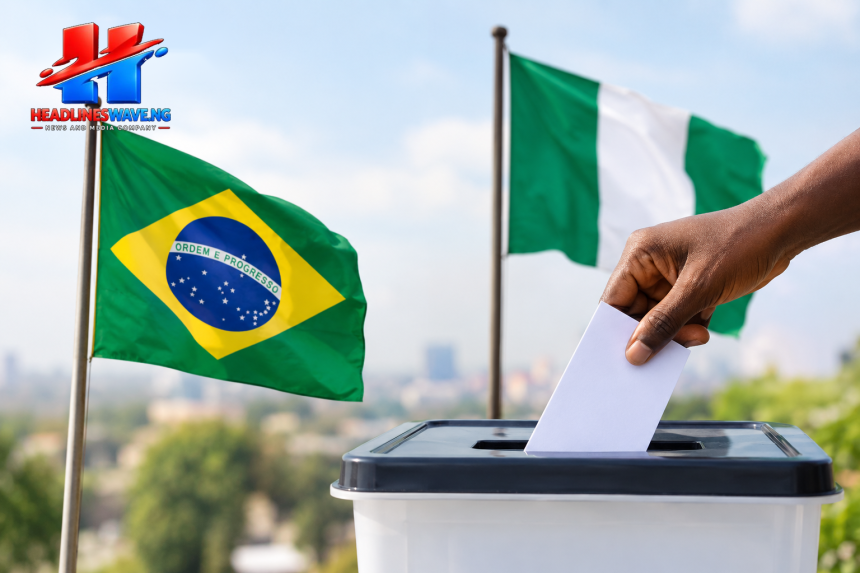
Brazil’s presidential election should give Nigeria serious food for thought.
On Sunday, October 4, 2026, millions of Brazilians went to the polls in a closely fought presidential election that has produced a runoff between President Luiz Inácio Lula da Silva and Senator Flávio Bolsonaro.
But beyond the candidates and political contest, there is one feature of the Brazilian election Nigeria should pay particular attention to + citizens’ participation.
Brazil has about 159 million registered voters. Preliminary figures indicate that roughly 125 million people turned out for the first round.
More Read

That is remarkable.
Nigeria and Brazil have some striking similarities. Both are among the world’s most populous countries. Both are major developing economies with enormous natural resources, including oil.
Both have large youthful populations and face serious challenges of poverty, inequality, insecurity and economic pressure.
More Read
Yet our electoral participation remains disturbingly low.
In Nigeria’s 2023 presidential election, INEC recorded 93.47 million registered voters, but only about 25.29 million accredited voters. Total votes cast were below 25 million.
That should concern us.
Democracy Needs Citizens
Nigerians are quick to complain about bad governance, unemployment, insecurity, inflation, poor infrastructure and the rising cost of living.
But democracy cannot deliver the government people desire if citizens continually withdraw from the most important process through which they can influence who governs them.
Voting is not merely a civic ritual. It is a powerful instrument of accountability.
More Read

When millions stay away from elections, they leave the decision to the smaller number that turns up.
This is why Nigeria must look beyond political parties and candidates and examine the behaviour of the electorate itself.
We Have The Population. Where Is The Participation?
Nigeria has one of the largest populations in Africa. We have millions of young people who complain every day about the state of the nation.
The question is: how many of them will actually participate when the opportunity comes?
Of course, Nigerians deserve credible elections. INEC must continue to improve.
Political parties must become more democratic. Electoral violence, vote buying and intimidation must be confronted.
But citizens also have a responsibility.
We cannot demand accountability from politicians while refusing to participate in choosing them.
The 2027 Lesson
As Nigeria approaches the 2027 general elections, the Brazilian experience should remind us of something fundamental:
A democracy is only as strong as the participation of its citizens.
The question should not only be, “Who are you supporting?”
It should also be:
“Will you vote?”
Nigeria does not lack people. We do not lack intelligent citizens. We do not lack political awareness.
What we need is to convert our population into electoral power and civic responsibility.
Brazil has demonstrated that tens of millions of citizens can make their voices heard at the ballot box.
Nigeria must learn to do the same.
We must vote. We must protect our votes. And whoever emerges must be held accountable.
The future of Nigeria cannot be left to the few who show up.

This editorial draws on official electoral data from Brazil’s Tribunal Superior Eleitoral (TSE) and Nigeria’s Independent National Electoral Commission (INEC), alongside current reporting on Brazil’s 2026 election.