2027 PRESIDENTIAL RACE
Three front-runners. Three different political paths. One question: Who has the clearest route to Aso Rock?
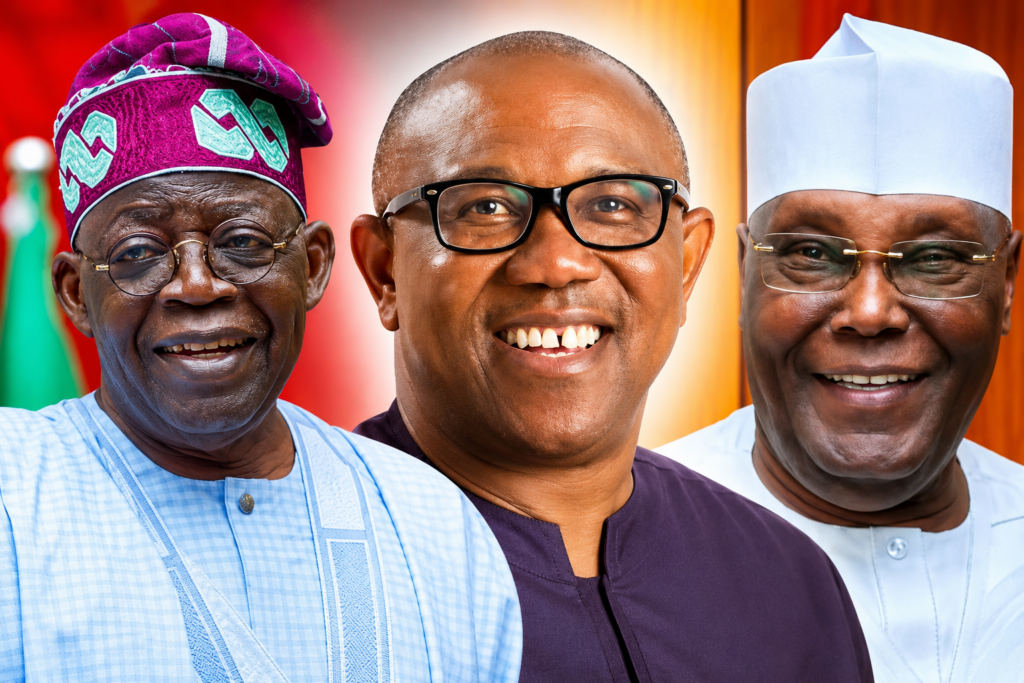
Nigeria’s 2027 presidential contest is taking shape around three heavyweight contenders: President Bola Ahmed Tinubu of the APC, former Vice President Atiku Abubakar of the ADC, and former Anambra State Governor Peter Obi of the NDC.
They represent three distinctly different propositions.
Tinubu offers incumbency, experience and a formidable political structure.
Atiku offers extensive federal experience, a strong northern political network and a long-established opposition base.
Obi offers a different political proposition: a strong reform-oriented identity, significant youth appeal, a record as a former governor, and perhaps the strongest current public-sentiment momentum among the three.
But what happens when the candidates are examined beyond campaign posters and partisan narratives?
1. BOLA AHMED TINUBU — THE POWER OF INCUMBENCY
Tinubu’s biggest advantage is obvious: he is the sitting President.
The APC has moved to secure his second-term bid, with Vice President Kashim Shettima submitting Tinubu’s nomination and expression-of-interest forms in May 2026.
That gives him access to perhaps the most formidable political machinery in the contest.
Tinubu’s advantages
Incumbency: He controls the federal executive and has the visibility that comes with being President.
Strong political structure: The APC has governors, National Assembly members and a nationwide political organisation.
Political experience: Tinubu has decades of experience in Nigerian politics, including his years as Lagos governor and his role in building the political coalition that eventually produced the APC.
An economic-reform argument: His administration can point to major reforms, including fuel-subsidy removal and exchange-rate reforms, and argue that difficult decisions were necessary to restructure the economy.
But the biggest question for Tinubu is performance.
The 2027 election could effectively become a referendum on whether Nigerians believe the pain associated with the administration’s reforms is producing sufficient results.
Cost of living, inflation, jobs, insecurity and the purchasing power of Nigerians will be central campaign issues.
And the latest SBM Intelligence Voter Sentiment Tracker provides a warning for the incumbent: Tinubu recorded a net favourability score of -58.5, while his ratings on inflation, security, jobs and electricity were reported as below “poor” in almost every geopolitical zone.
Tinubu’s biggest weapon is therefore structure. His biggest vulnerability is public perception of his performance.
Tinubu’s 2027 position:
VERY STRONG POLITICAL STRUCTURE — BUT UNDER PRESSURE FROM PUBLIC SENTIMENT.
2. ATIKU ABUBAKAR — EXPERIENCE, NETWORK AND THE ZONING QUESTION
Atiku remains one of Nigeria’s most experienced presidential contenders.
He was Vice President from 1999 to 2007 and has contested the presidency several times. His extensive political network, particularly across northern Nigeria, remains an important asset.
Atiku’s advantages
Extensive federal experience
He understands the workings of the presidency and the complexities of national politics.
Strong northern network
Atiku has maintained a substantial political base in the North and relationships extending across different parts of the country.
Opposition credentials
He has consistently positioned himself as an alternative to the ruling party and has a deep understanding of presidential campaigns.
But Atiku has a major 2027 problem: ZONING.
This is not a constitutional barrier. Nigeria’s Constitution does not require the presidency to rotate between North and South.
But Nigerian politics has developed a powerful political convention around zoning and rotation, and that reality cannot simply be wished away.
The political argument is straightforward:
Tinubu is a Southern president seeking another term. Peter Obi is a Southern candidate. The NDC has formally zoned its 2027 presidential ticket to the South for a single four-year term.
Atiku, meanwhile, is a northern candidate seeking the presidency immediately after a southern president’s first term.
Indeed, Atiku’s camp has explicitly rejected the argument that opposition parties should automatically zone their presidential ticket to the South, insisting that electoral strategy should take precedence over zoning.
That is a legitimate political argument.
But it also exposes the difficulty confronting his candidacy.
The Atiku dilemma
If the electorate is primarily voting on competence, experience and policy, Atiku remains highly competitive.
But if the 2027 election becomes partly a question of regional rotation and whether it is time for another southern president, his candidacy faces an additional hurdle.
There is another challenge: the opposition vote is no longer united behind one platform.
The earlier attempt to bring Atiku, Obi and other opposition figures together under the ADC collapsed after Obi and Rabiu Kwankwaso left and subsequently joined the NDC. Reuters reported that the split could lead to opposition votes being divided again.
Atiku’s 2027 position:
EXPERIENCED AND FORMIDABLE — BUT FACING THE ZONING QUESTION AND A FRACTURED OPPOSITION.
3. PETER OBI — THE REFORM CANDIDATE WITH MOMENTUM
What actually makes Peter Obi stand out?
His record as a former governor
Obi’s political appeal is closely linked to his record and the way he presents public finance, accountability and investment in human capital as central to governance.
His reputation for fiscal prudence
His supporters point to his emphasis on saving, reducing waste and directing resources toward areas such as education, health and infrastructure.
His reform-oriented political identity
Obi has built a political brand around reducing waste, strengthening institutions, improving productivity and moving Nigeria from a consumption-driven economy toward production and investment.
Youth and first-time-voter appeal
His 2023 campaign created a political movement that extended beyond conventional party structures. The Financial Times previously noted that Obi’s campaign particularly energised young and urban voters, even though the movement struggled with the organisational depth of traditional political machines.
Strong current public sentiment
This may currently be Obi’s most important advantage.
The latest SBM Intelligence Voter Sentiment Tracker surveyed 829 respondents across all six geopolitical zones.
Its findings are striking:
Peter Obi recorded a +58.3 net favourability score — the only one of the major candidates in positive territory.
The survey reported that Obi led in favourability in every zone except the Northeast. Even in the Southwest, President Tinubu’s political home base, Obi’s net favourability was reported at +28.9 compared with Tinubu’s +15.1.
That does not mean Obi has won the election.
But it means that the Obi phenomenon is no longer something that can responsibly be dismissed as merely a social-media movement.
THE OTHER SIDE OF THE OBI STORY
Obi’s strengths must also be tested against his weaknesses.
1. Popularity must become votes
The biggest question is whether Obi can convert favourable sentiment into actual votes across enough states.
Nigeria’s presidential election is not won simply by having the largest online following or the strongest favourability rating.
The candidate must build a geographically broad electoral coalition.
2. Political structure
Tinubu has the APC machine.
Atiku has decades of political networks.
Obi’s challenge is building an equally effective nationwide polling-unit structure capable of translating enthusiasm into votes.
3. His record and controversies must be examined honestly
The claim that Obi has “no allegations” should not be used as a blanket statement.
He has faced controversies, including questions arising from the Pandora Papers, which he has denied as evidence of wrongdoing.
But the distinction is crucial:
political allegations or controversies are not the same thing as criminal convictions.
A credible assessment of Obi should therefore focus on his record, policies, public finances, accountability claims and what he proposes to do with presidential power — rather than portraying him as beyond scrutiny.
That actually makes the argument for him stronger, not weaker.
4. He now has a more interesting national proposition
Obi’s move into the NDC has changed the political calculation.
He is no longer simply the 2023 Labour Party candidate repeating the same strategy.
The NDC has formally zoned its presidential ticket to the South, while the party’s presidential ticket now pairs Obi with former Kano governor Rabiu Kwankwaso.
That combination potentially gives Obi something his 2023 campaign lacked in sufficient measure – a stronger northern political bridge.
Kwankwaso brings a substantial political identity in Kano and the wider North, while Obi brings a strong southern and youth-oriented constituency.
Whether that becomes a genuinely nationwide coalition is one of the biggest questions of the 2027 election.
Yes, the Obi-Kwankwaso ticket potentially strengthens the NDC’s northern reach, but its actual electoral effect remains to be demonstrated.
SO, WHO CURRENTLY STANDS OUT?
PETER OBI — ON CURRENT PUBLIC SENTIMENT
If the question is who currently stands out on public sentiment, Peter Obi has the strongest case.
Not because he is beyond criticism.
Not because the election has already been won.
And certainly not because a campaign poster says so.
The strongest evidence is that the latest SBM Intelligence survey places Obi at +58.3 net favourability — dramatically ahead of the other major candidates in that measure.
But the race is far from over.
Tinubu has what Obi does not: the power of incumbency and a massive political machine.
Atiku has what Obi does not: decades of national political experience and an established northern network.
Obi currently has what neither appears to possess to the same degree: strong cross-regional favourability combined with a highly motivated grassroots and youth-oriented political movement.
That is why Obi currently stands out in this snapshot — but he still has the hardest job of all: converting enthusiasm into a nationwide electoral coalition.
2027 PRESIDENTIAL RACE: OUR CURRENT PROGNOSIS
PETER OBI — MOMENTUM LEADER
Strongest current favourability, a powerful reform-oriented identity, significant youth appeal and a potentially strengthened national coalition through the NDC/Kwankwaso ticket.
BOLA AHMED TINUBU — STRUCTURE LEADER
The incumbent remains extremely formidable because of incumbency, APC machinery and political experience. His major challenge is convincing Nigerians that his administration’s economic reforms are delivering enough tangible improvement.
ATIKU ABUBAKAR — EXPERIENCE LEADER
Still a major national contender with considerable political experience and northern reach. But the zoning question, the fragmentation of the opposition and competition from Obi’s NDC make his route more difficult.
THE BIG QUESTION FOR NIGERIA
The 2027 election may ultimately come down to three competing forces:
TINUBU’S STRUCTURE
ATIKU’S EXPERIENCE
OBI’S MOMENTUM
And the candidate who successfully combines popularity + structure + national spread + voter turnout could emerge as Nigeria’s next President.
NOW, LET NIGERIANS HAVE THEIR SAY:
If the presidential election were held today, who would you choose?
🟢 PETER OBI — NDC
🔵 BOLA AHMED TINUBU — APC
🟠 ATIKU ABUBAKAR — ADC
And most importantly: WHY?
This is an informal reader survey, not a scientific opinion poll. The 2027 race remains fluid, and alliances, economic conditions, party structures and voter turnout can still change the political landscape.
HEADLINESWAVE | POLITICAL ANALYSIS